.png)
Updated August 19, 2026
Service level agreements (SLA) are easy to define on paper. The harder part is running the day-to-day service operation required to meet them consistently.
When a client request arrives, someone needs to determine its urgency, assign ownership, understand the client context, respond within the agreed timeframe, and keep the work moving until resolution. Multiply that across clients, teams, and hundreds of requests, and SLA performance becomes less about the wording of the agreement and more about how effectively the work is managed.
A well-designed ticket management process provides service teams with a consistent way to capture requests, assign ownership, track response and resolution times, and identify work that needs attention. For professional services firms, ticketing management also needs to preserve the client and delivery context surrounding the request rather than treating every ticket as an isolated support interaction.
What is SLA Management?
SLA management is the process of defining, monitoring, and improving the service commitments made between a provider and its clients.
Those commitments vary by business and contract, but often include targets such as:
- First-response time: How quickly someone acknowledges and begins addressing a request.
- Resolution time: How long the team has to resolve the issue.
- Availability or uptime: The level of service availability promised to a client, where applicable.
- Escalation requirements: What should happen when an issue becomes urgent or is at risk of missing its target.
- Service scope: Which requests, clients, or services are covered by the agreement.
The agreement sets the expectation. SLA management is what turns that expectation into an operating discipline.
How Does a Ticketing System Support SLA Management?
A ticketing system creates a record for each service request and gives teams a structured way to manage it from intake through resolution.
Tracking requests is important because SLA performance depends on knowing when a request arrived, who owns it, its current status and priority, what communication has already occurred, and how much time remains against the relevant commitment.
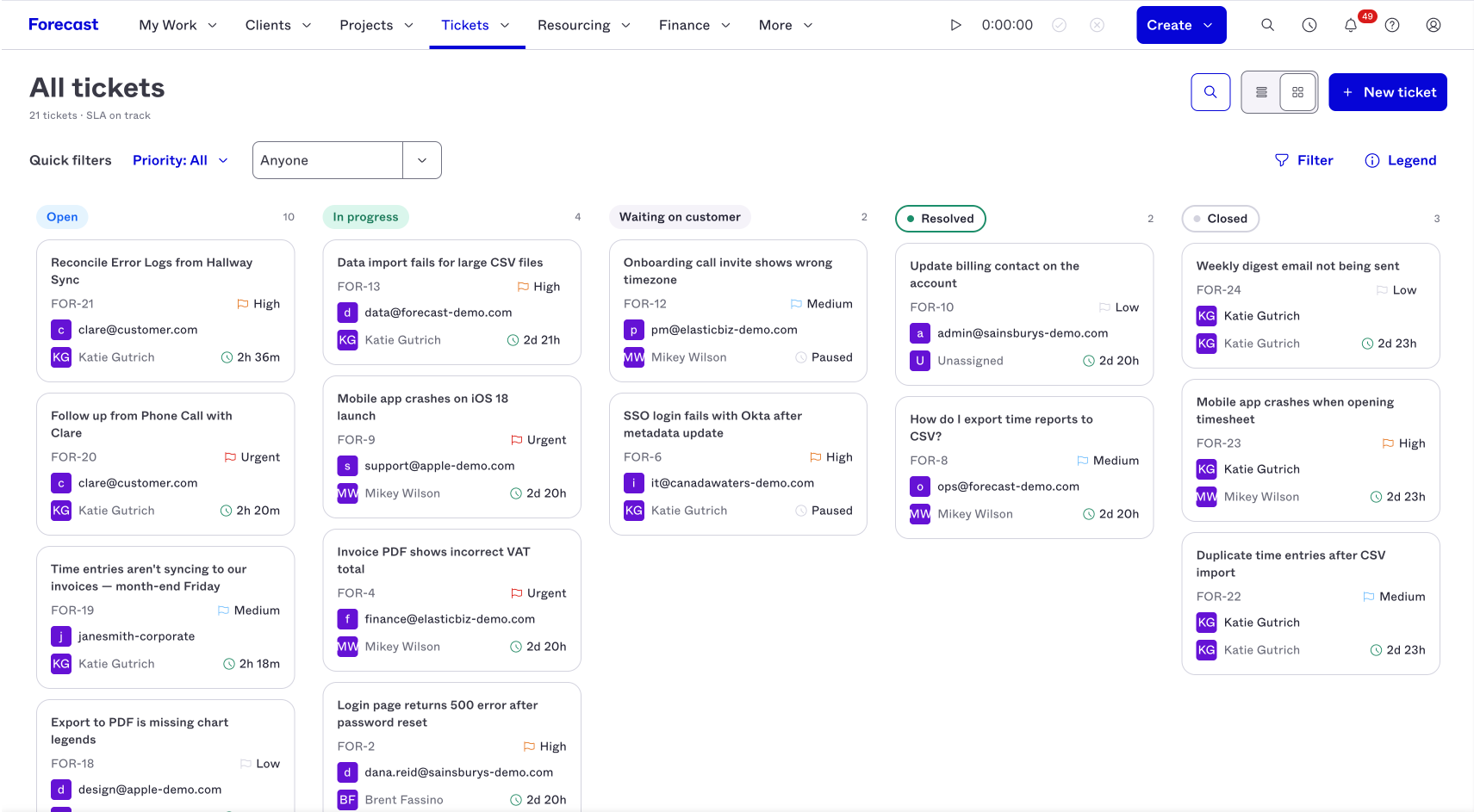
Without that structure, teams often end up reconstructing the same information from email threads, chat messages, project records, or individual inboxes. The problem is not simply administrative inconvenience. Fragmented information makes it harder to prioritize accurately and easier for a request to lose momentum.
Ticketing gives SLA management an operational home. The system itself, however, does not create good SLA performance. The process around it does.
How to Improve SLA Performance Through Better Ticket Management
Meeting SLAs consistently requires more than tracking deadlines; it depends on how requests are prioritized, owned, managed, and reviewed.
1. Build SLA targets from delivery capacity.
An aggressive SLA is not necessarily a good SLA.
Response and resolution targets should reflect the type of service being provided, the severity of the request, staffing levels, operating hours, and the amount of work the team can reasonably absorb. Historical performance is particularly useful here: it shows what the business has actually delivered rather than what sounds competitive during contract negotiations.
This is also where response time and resolution time need to be separated.
A team may acknowledge an urgent request within an hour without being able to solve it in that time. Treating those as the same commitment creates unrealistic expectations for clients and distorted performance incentives for the team.
2. Define what starts, pauses, and completes the clock.
Ambiguous SLA timing causes problems long before a deadline is missed.
Teams should agree on exactly when measurement begins and what constitutes a response or resolution. They should also decide how waiting periods are treated.
For example, what happens when the team cannot proceed until the client provides additional information? Does the resolution clock continue running? Does it pause? What happens when a ticket is reopened?
These rules should be explicit rather than left to individual interpretation. Otherwise, two people can handle equivalent tickets differently while both believing they are following the SLA.
3. Use ticket priority to drive attention, not just classification.
Priority is useful only when it changes what happens next.
A high-priority ticket should be easier to identify, review, and act on than a routine request. That does not mean everything a client labels “urgent” should automatically become urgent internally. Teams need consistent criteria for assessing business impact, severity, contractual commitments, and the consequences of delay.
Good prioritization prevents two common failures: genuinely important requests disappearing into a busy queue, and too many tickets being treated as exceptional until the priority system becomes meaningless.
4. Make approaching SLA risk visible.
A breached SLA is a lagging indicator. By the time it appears in a report, the service failure has already happened.
The more useful question is: Which tickets are likely to breach soon?
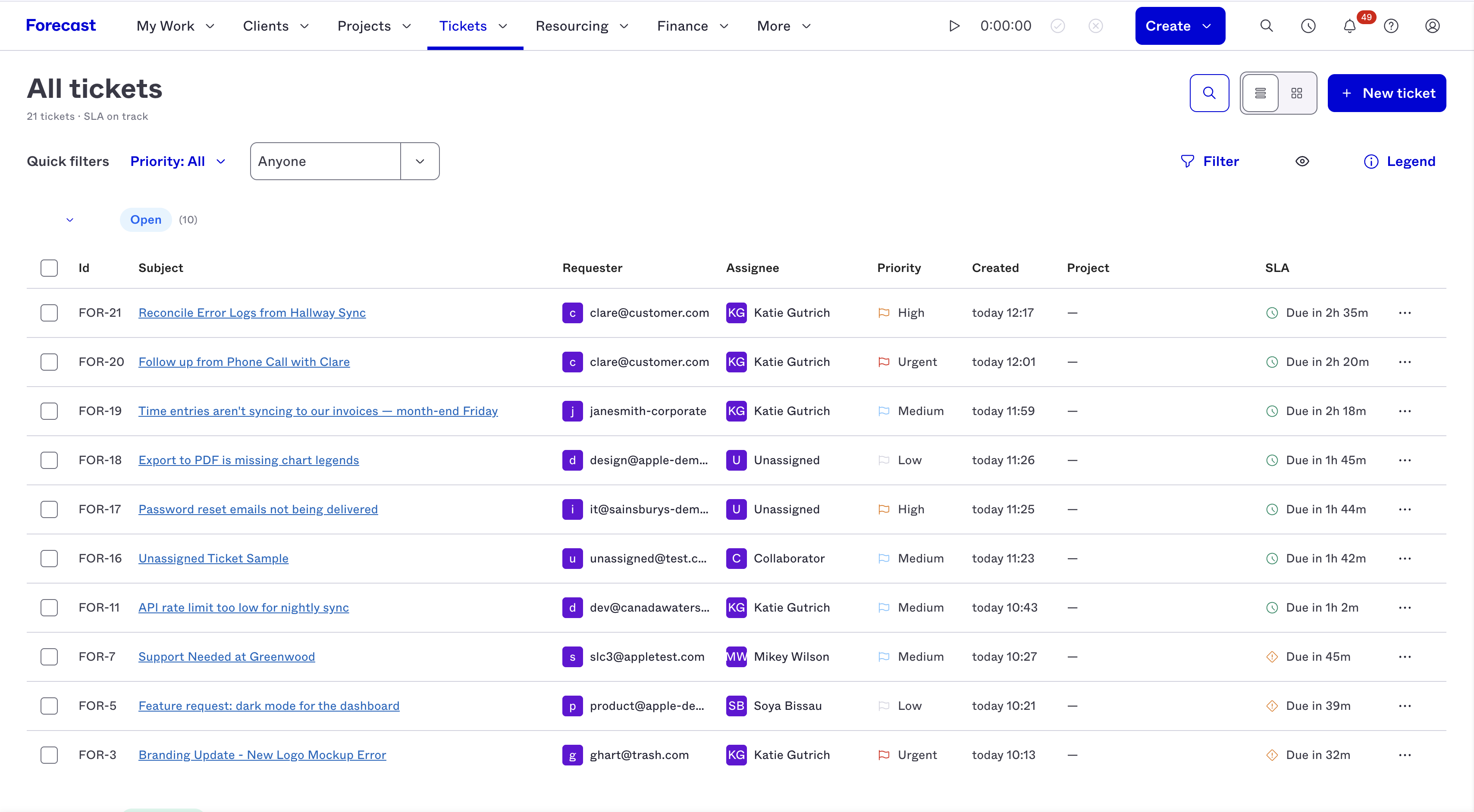
Teams need enough visibility into ticket age, status, ownership, and SLA timing to intervene while there is still time to change the outcome. Managers should be able to distinguish work that is comfortably on track from work that needs attention without manually inspecting every open request.
That visibility is especially important when ticket volume increases, or responsibility moves between people. An SLA should not depend on one person remembering that a deadline is approaching.
5. Keep ownership clear throughout the ticket lifecycle.
Every active ticket should have an obvious owner.
That sounds elementary, but ownership often becomes unclear during handoffs: a specialist is consulted, an account manager joins the conversation, the client replies after several days, or someone assumes another team is handling the next step.
A ticketing process should make the current assignee, status, and next action easy to understand.
Clear ownership does not mean one person must do all the work. It means there is never ambiguity about who is responsible for moving the request forward.
6. Keep the client context close to the ticket.
A service request rarely exists in isolation.
The right response may depend on the client's current projects, previous conversations, contractual relationship, other open issues, or commitments already made elsewhere in the business.
When ticketing operates separately from the rest of client delivery, service teams spend time searching for that context or asking colleagues to reconstruct it. More importantly, they can make decisions without seeing information that should influence how the request is handled.
For professional services firms, this is one of the most important distinctions between simply maintaining a support queue and managing service delivery well: the ticket should be part of the client relationship, not a separate universe. To see how Accelo integrates ticketing with client work and project work, book a demo.
7. Review SLA performance for patterns, not just percentages.
An overall SLA compliance percentage is useful, but it rarely tells you what to fix.
Look underneath the headline number.
Which types of tickets breach most often? Are certain priorities consistently misclassified? Do delays occur before first response or later in the resolution process? Are handoffs creating bottlenecks? Are particular clients or service types generating more work than the SLA model anticipated?
Those patterns can reveal problems in staffing, scope, triage, workflow, or even the SLA itself. Reviewing historical SLA performance can help teams identify trends and make adjustments that improve service delivery over time.
The goal is not simply to report whether the team met its SLA. It is to understand why—or why not.
Which SLA metrics should professional services teams track?
The right SLA metrics will vary depending on your service model, but most teams benefit from starting with a core set of measures that consistently reflect both SLA performance and overall service health:
First-response time. How long does a client wait before receiving a meaningful response?
Resolution time. How long does it take to resolve a request?
SLA attainment. What percentage of tickets meet the applicable response and resolution targets?
SLA breach rate. How frequently are commitments missed, and where are those breaches concentrated?
Ticket volume and backlog. Is demand increasing faster than the team can resolve it?
Ticket age. How long have unresolved tickets remained open?
Reopened tickets. Are requests being marked resolved before the underlying issue is actually settled?
Do not treat these metrics in isolation. A team might improve first-response time simply by sending quicker acknowledgments, while resolution times quietly worsen. Or it may reduce backlog by closing tickets too early. These numbers only become meaningful when they’re viewed together and connected back to the actual client experience.
The goal is to use SLA metrics to improve service delivery, not to optimize the numbers at the expense of the client experience.
Where Ticketing Fits into a Connected Service Operation
For professional services organizations, ticketing becomes more useful when it does not force delivery teams to operate separately from the rest of the client relationship.
That is the direction Accelo takes with ticketing.
Accelo's ticketing module is designed to bring support requests into the same broader environment where teams manage client work. Requests received via a configured support email address can be converted into tickets, with the email subject, message, and attachments captured as part of the request. Where a matching client contact exists, that requester can be connected with existing client information.
Within the ticket, teams can manage details such as assignee, status, priority, labels, requester, and communication history. The aim is straightforward: give the person handling the request enough context to understand what is happening without making them piece the client story together across disconnected tools.
That connected context is particularly valuable for professional services firms, where support, project delivery, account management, and ongoing client work frequently overlap.
Accelo also includes SLA tracking as part of this ticketing feature, with response-time and resolution-time thresholds and clearer visibility into tickets that are within target, approaching their thresholds, or have breached them.
The point is not to add another system for teams to maintain. It is to make service requests easier to manage alongside the rest of the client work already taking place. Want to streamline your SLA tracking and service delivery? Book a demo to learn how Accelo can streamline your processes and drive better business outcomes.
Frequently Asked Questions About SLA Management
What is an SLA in a ticketing system?
An SLA in a ticketing system defines the service commitments tied to a request, such as how quickly the team should respond or resolve the issue. The ticket gives the team a way to track that request against those commitments from intake through resolution.
What is the difference between response time and resolution time?
Response time measures how long it takes the service provider to respond to a new request. Resolution time measures how long it takes to resolve the request. Because complex issues may require considerably more work after the initial response, the two should usually be tracked separately.
How can a ticketing system help prevent SLA breaches?
A ticketing system can make ticket age, priority, ownership, status, and SLA timing visible in one place. That gives teams a better chance to identify at-risk requests and intervene before the deadline rather than discovering the problem after a breach.
How often should SLAs be reviewed?
There is no universal SLA review schedule. Teams should revisit SLAs when performance data shows recurring problems, service scope changes, client requirements change, or staffing and capacity materially shift. Regular reviews can also reveal targets that no longer reflect how the service is actually delivered.
What should professional services firms look for in an SLA ticketing system?
Look beyond basic ticket creation. An SLA ticketing system should support clear ownership and prioritization, preserve communication history, make response and resolution performance visible, and provide enough client context for the team to make informed decisions. For professional services organizations in particular, consider how ticketing connects to the client and delivery information the business already relies on.
This article was originally published on April 17, 2025, and was updated for accuracy and relevancy on August 19, 2026.




.svg)



.svg)