The loudest AI promises in professional services right now are about execution.
Automated workflows. Agents that take action on your behalf. Systems that, once set in motion, can do the work without constant human intervention. It's a compelling story, and investment capital is flowing toward it at a remarkable rate.
But here's the question before you buy in: what, exactly, are those agents executing on?
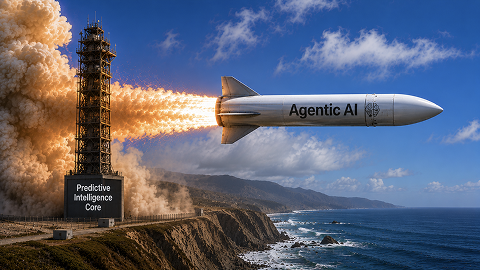
Because if the answer is a flawed scope, an optimistic resource plan, or a forecast built on instinct rather than data, then what you've built is a faster rocket headed in the wrong direction.
The Real Problem Isn't Execution. It's What Happens Before It.
Professional services firms are under real financial pressure right now, and the numbers make that hard to ignore. According to SPI Research 2025 Professional Services Maturity™ Benchmark, EBITDA fell from 15.4% in 2023 to just 9.8% in 2024, the lowest point in five years. Revenue growth slowed to 4.6%, well below the five-year average of 8.7%. Project overruns rose 11.3%. On-time delivery dropped to 73.4%.
That's a consistent, multidimensional squeeze, and it's happening even as most firms are actively investing in AI and automation.
So if AI spending is up, why are margins going down?
The answer, in most cases, isn't found in how work gets executed. It's found in the decisions made before a single hour gets logged. SPI's own research identifies poor forecasting and scope creep as primary contributors to this erosion. And when you trace most project failures back to their source, they don't start on day 15 of delivery — they start at the proposal stage, the scoping conversation, or the resource allocation decision made before the engagement kicked off.
What Agentic AI Gets Right — And Where It Stops
To be clear: agentic AI is genuinely useful. Accelo includes it. Systems that can monitor project status, flag a blocked task, trigger a workflow, or surface a status update without someone having to manually compile a report — that's actual time recovered. For professional services firms drowning in coordination overhead, that matters.
Accelo wasn’t built around the agentic layer. It was built around what sits underneath it: a predictive intelligence core that informs decisions at the proposal stage, in the resource plan, and in the financial forecast – before execution ever begins. Because most PSA platforms tell you what happened. Accelo’s goal was to build one that shows you what’s coming.
What most software vendors won’t tell you is that there's a ceiling to what execution-layer AI can do, and that ceiling is set by the quality of what sits above it. Think about it this way:
- An agent that auto-schedules your engineers against project demand can only be as accurate as your demand forecast.
- An agent that monitors project health can only catch drift after work has started — which, by definition, is after you've already made the commitments that are hardest to undo.
- An agent that automates client status updates will move faster, but faster is only better if what's being communicated reflects reality.
Gartner flagged this dynamic directly in research published in early 2025, finding that 63% of organizations either don't have or aren't sure they have the right data management practices to support AI, and predicting that 60% of AI projects lacking AI-ready data will be quickly abandoned. Take that as a huge structural warning about what happens when the automation layer outpaces the intelligence layer.
McKinsey's research makes the same point in starker terms: nearly two-thirds of enterprises have experimented with AI agents, but fewer than 10% have scaled them to deliver tangible value. And in their most recent work on agentic AI specifically, they found that 80% of companies cite data limitations as their primary roadblock to scaling agents, cautioning companies against the temptation to rely on AI advancements to shortcut data architecture best practices.
In other words, the agents aren't the problem; the foundation they're built on is. Do you have a solid AI foundation?
Garbage in, agents out. The phrase is blunt, but it's accurate.
The Automation Trap: Faster Execution of the Wrong Plan
There's a specific failure mode worth naming, because it's subtle enough to look like success for a while.
When you layer automation on top of broken upstream inputs, you don't eliminate the problem — you accelerate it. Misallocated resources get scheduled faster. Under-scoped projects are kicked off more efficiently. Margin-negative engagements get executed at higher velocity. The output looks like productivity. The P&L tells a different story.
This is the automation trap: investing in making things move faster without first ensuring you're moving in the right direction.
In professional services, direction-setting occurs at the proposal stage, in the resource plan, and in the forecasted outcomes. Those aren't operational decisions; they're strategic ones, and they happen before any agent enters the picture. If AI isn't present at that moment, then by the time it shows up to help with execution, the most consequential choices have already been made without it.
What Upstream AI Actually Looks Like in Practice
Predictive intelligence — AI that operates at the decision layer, not just the execution layer — changes the economics of professional services at the point where the money is actually won or lost. As an example, here’s how AI spans across the project lifecycle in Accelo:
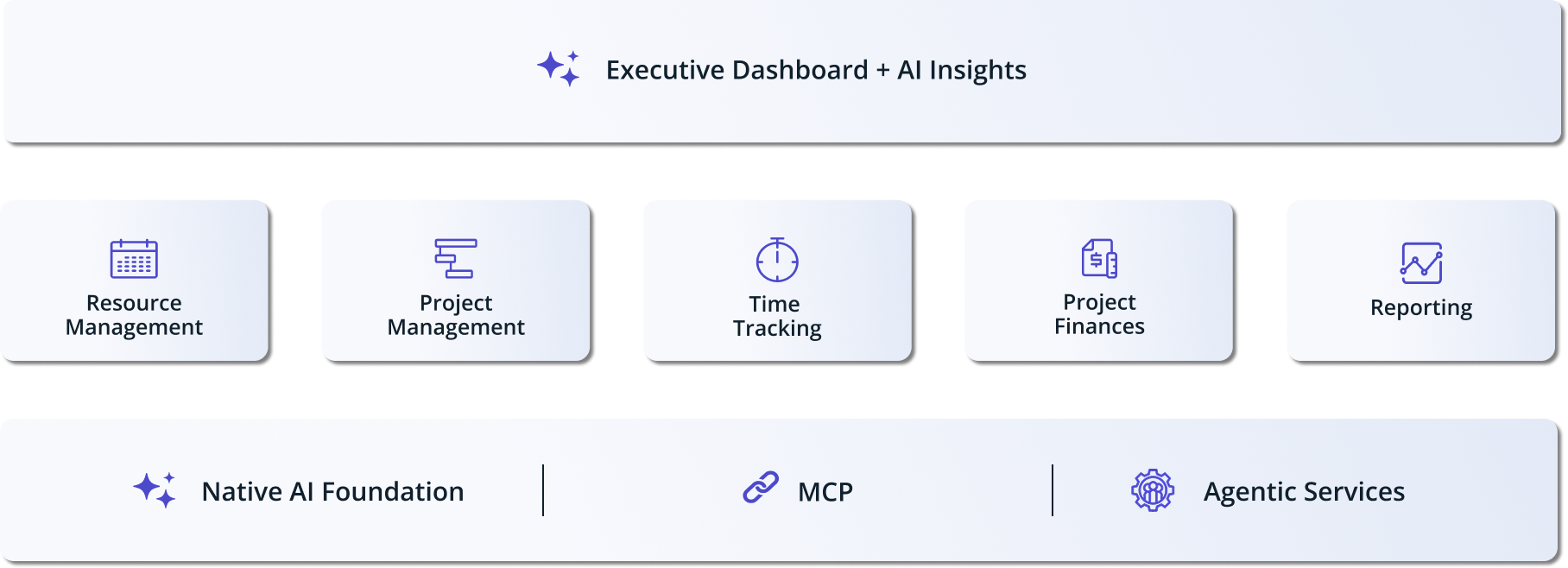
What it looks like in practice:
- Capacity gaps are flagged before a contract is signed – so hiring decisions are strategic, not reactive. Firms using Accelo for capacity planning report 5-8% gains in utilization efficiency.
- Predictive project outcomes based on your historical project data – signals that identify when an engagement is likely to miss a deadline based on current pacing—along with recommended corrective actions.
- More efficient resource allocation, with AI making resourcing recommendations based on skills, past performance, availability, and project needs. Accelo customers report up to 50% less time spent on resource planning and allocation.
- Forecasted profitability before work begins – giving leadership the visibility to course correct sooner, reducing margin erosion.
That’s the difference between intelligence and automation. Automation executes. Intelligence informs. And in professional services, informing the right decisions before work starts is worth far more than optimizing work once it's underway.
SPI's 2025 benchmark makes this explicit: firms leveraging AI for resource planning and decision support are outperforming their peers by 2.5x — not the firms with the most automated workflows, but the ones with the best data visibility and the AI to act on it before a project goes sideways.
Firms with the best data visibility and the AI to act on it are outperforming their peers by 2.5x
This is also what Accelo is designed to do: build connected intelligence across delivery history, resourcing and capacity planning, project financials, and project performance metrics, making every upstream decision better.
4 Questions to Ask Before Your Next AI Investment
If you're evaluating any AI capability for your professional services firm right now, whether it's a new platform, an add-on module, or a standalone tool, these questions cut through the noise:
1. Does this AI inform decisions before work starts, or does it optimize work already in motion? Both have value, but they're not equivalent. Upstream intelligence has a higher leverage point.
2. What data is this AI trained on, and how specific is it to your operations? Generic AI built on generic data gives you generic output. The value lies in the specificity — your project patterns, utilization history, resource performance, and margin trends, to name a few. AI that learns and makes recommendations based on how your organization operates truly functions as a business partner.
3. If the inputs are wrong, what does this AI do? Automation accelerates. If the inputs are flawed, it accelerates in the wrong direction. Do you have data consistency, or is it fragmented across various tools and inputs?
4. Can this AI help you avoid a bad project, or does it only help you manage one? There's a meaningful gap between the two. One protects margin. The other manages damage.
The Firms That Win Won't Have the Most Automated Execution
Agentic AI and execution automation are not going away — nor should they. But the firms that will look back on 2026 as the year they pulled ahead aren't the ones who moved fastest on agentic automation. They're the ones who invested in the intelligence layer first: in data visibility, in predictive forecasting, in AI that makes the decisions upstream before agents downstream ever get involved. Assess your AI readiness now.
The question isn't whether to adopt AI. It's whether your AI is in the room when the decisions that determine your margin are being made — at the proposal, the resource plan, the go/no-go.
The firms that will look back on 2026 as the year they pulled ahead won't have the most automated execution layer. They'll have the best decision quality going into it.
Your data is telling you a story right now. The question is whether you're hearing it in time to act.
Accelo, now with Forecast, was built on a predictive intelligence core encompassing the full professional services lifecycle, from the proposal stage through resource allocation, project delivery, and financial performance. Learn how Accelo’s native AI capabilities can help you improve performance and make better decisions before work begins. Book time with our team.


.svg)


.svg)