Key Takeaways
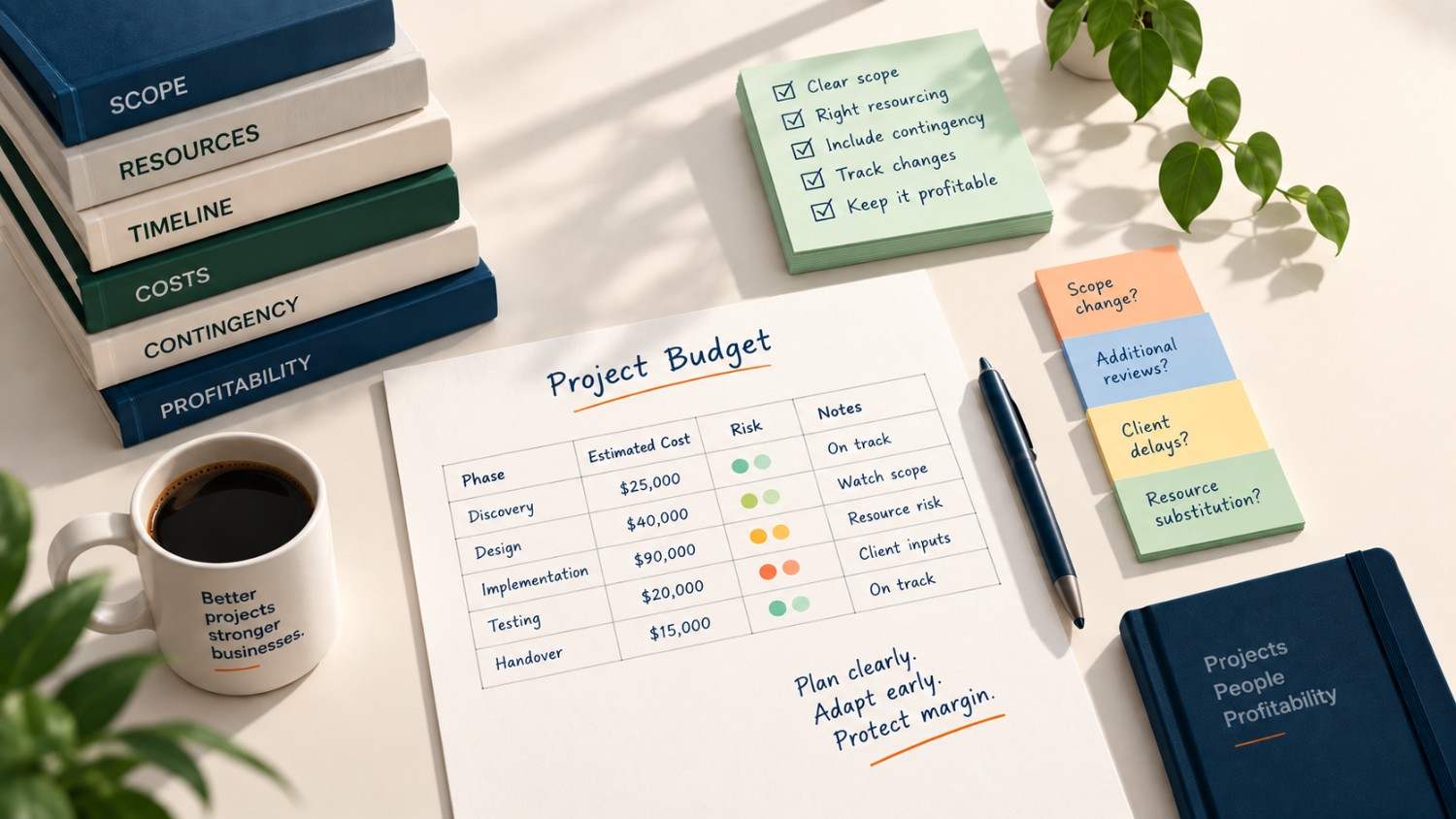
- A reliable project budget starts with clear scope boundaries, assumptions, dependencies, and acceptance criteria.
- Labor estimates should reflect the planned resource mix, not just total hours, because staffing changes can materially affect project margin.
- Tie contingency to identifiable delivery risk rather than applying the same default percentage to every project.
- Budget variance often begins with ordinary delivery changes, including additional review cycles, resource substitutions, delayed client input, or incomplete time data.
- AI can improve project budget accuracy by recognizing patterns across similar work and continuously forecasting completion dates, remaining effort, and expected profitability as delivery progresses.
A project budget can be accurate at kickoff and still become unreliable six weeks later.
Professional services work rarely unfolds exactly as it was scoped. Client feedback takes longer than expected, a planned resource becomes unavailable, delivery uncovers work that wasn't visible during estimation, or a seemingly small request triggers another round of review. None of those changes automatically means the project was budgeted incorrectly. The problem starts when the financial model keeps reflecting the original assumptions after delivery has moved on.
That is the harder part of learning how to create a project budget. You are not trying to produce one perfect number before kickoff. You are building a financial baseline that makes changes in scope, staffing, cost, and margin visible early enough to act.
The 2025 SPI Professional Services Maturity Benchmark found that roughly 1 in 9 professional services projects runs over budget. The starting estimate matters, but what happens after approval often determines whether the project finishes anywhere close to that estimate.
How to Create a Project Budget Before You Price the Work
Budget risk starts when the client commitment is more specific than the delivery assumptions behind it. Before estimating cost, the project needs to be clear enough that sales, delivery, finance, and whoever approves the proposal are all pricing the same engagement.
Define what “done” actually means.
Start with the assumptions most likely to change the economics later. What exactly will the client receive? How many review cycles are included? Which inputs must the client provide, and by when? Who approves the work? What is clearly outside the agreed scope?
Those details can change the estimate more than the headline deliverable.
If the budget assumes one 60-minute stakeholder session but delivery ultimately requires separate workshops with eight regional teams, the original cost assumptions no longer hold. The budget may be off before anyone exceeds their planned hours.
Likewise, if a fixed-fee implementation assumes clean client data but the team later spends a week correcting it, the cost model has changed even if the scope document has not.
The budget should therefore capture the boundaries that affect effort and cost: deliverables, exclusions, acceptance criteria, client dependencies, review assumptions, approval responsibilities, and timing assumptions. At this point, scope stops being contract language and becomes an input to the financial model.
Break the scope into estimable work.
Once the boundaries are clear, divide the engagement into phases or work packages that reflect how delivery will actually happen.
The structure should mirror the points where effort, staffing, cost, or risk materially change across the engagement. That might mean separating discovery from implementation, production from client review, or design from specialist review and permitting. The objective is not to create a more detailed work breakdown structure, but to make the assumptions driving the budget visible where they can change.
Each phase should connect to the expected effort, required roles, direct costs, the assumptions behind the estimate, and the person responsible for delivery.
The GAO Cost Estimating and Assessment Guide takes a similar approach, treating scope, work breakdown, assumptions, source data, risk, documentation, and actual-cost updates as connected parts of a credible estimate. The same principle applies to professional services work at a much smaller scale: if a meaningful cost cannot be tied to a defined piece of work or a documented assumption, part of the budget is still based on judgment rather than an explicit estimate.
Accelo’s project management capabilities extend that connection into delivery by bringing planned effort, actual activity, and project financials into the same operating view. That reduces the need to reconstruct project economics after the fact and makes it easier to see when budget assumptions start to diverge from delivery.
Build the Cost Model Around the Delivery Plan
For most professional services firms, labor is the largest project cost, but a labor estimate based only on total hours hides one of the variables most likely to affect margin: who actually performs the work.
Two projects can consume the same number of hours and still produce very different margins if one follows the planned resource mix while the other relies more heavily on higher-cost roles.
Estimate labor by role and phase.
Suppose a project is expected to require 200 consultant hours at an internal cost of $85 per hour and 40 director hours at $175 per hour. Planned labor cost is $24,000.
Now assume a capacity issue appears after kickoff and 50 of those consultant hours move to the director. The project still uses 240 hours, so a view based only on total hours can still show the project on plan. Labor cost, however, rises to $28,500.
With project revenue unchanged, that shift reduces expected margin by $4,500 even though the project has not exceeded its total hour budget.
That is why staffing and budgeting cannot be treated as separate exercises. A credible labor estimate needs to reflect the expected resource mix by phase, including delivery work, project management, quality assurance, senior oversight, client meetings, internal coordination, handoff, and any rework the team already expects to absorb.
Resource and capacity planning becomes part of the financial conversation because availability and role fit determine whether the project can be staffed according to the assumptions behind the budget.
Account for the internal work you already expect.
Professional services teams often exclude predictable internal effort because it will not appear on the client invoice. That does not mean the effort is cost-free.
Suppose four people attend a 30-minute internal project meeting every week for six months. That is roughly 52 hours of capacity. Add monthly leadership reviews, finance coordination, status reporting, account management, and invoice questions, and the difference between quoted effort and the actual cost of delivering the engagement can widen quickly.
Whether that work is billable is a pricing and contract decision. Whether it consumes capacity and affects margin is not.
This is particularly important in fixed-fee work, where additional internal effort does not create additional revenue. A project can therefore stay within the client-facing scope while its margin steadily declines because of work never included in the original estimate.
Include direct and third-party costs.
The same cost model should include project-specific expenses outside internal labor, such as contractors, external experts, travel, research, production costs, software, licenses, materials, permits, or other third-party services.
It is also useful to distinguish between pass-through costs and costs the firm intends to mark up, because they affect revenue and margin differently. If the financial model treats all third-party spend the same way, the project may look more or less profitable than it really is.
Match the Estimation Method to the Work
A recurring monthly engagement with stable scope does not require the same estimation process as a first-time implementation with uncertain data quality, six stakeholders, and an aggressive deadline.
The estimation method should reflect what the team knows and what uncertainty remains.
Use comparable projects when the underlying conditions match.
Historical projects are useful reference points when the scope, staffing model, timeline, client involvement, and delivery conditions are genuinely comparable.
A previous implementation may look like a strong reference until you find that it had one decision-maker instead of six, cleaner source data, a longer timeline, fewer senior resources, and two review cycles rather than five. The historical project still provides useful evidence, but copying its hours into a new estimate would ignore the variables that actually drove effort.
Past project data works best as a benchmark against the assumptions in the current estimate. If comparable projects typically required 300 hours and the current estimate is 180, ask what has changed to justify the difference.
Estimate from the bottom up when uncertainty is higher.
For larger or higher-risk work, estimate closer to the individual activities required to deliver it. Break each phase into meaningful tasks, identify the roles involved, estimate the expected effort and direct costs, and then roll those numbers into the project budget.
Bottom-up estimating takes more time before the proposal is approved, but it surfaces assumptions before you commit to pricing and delivery plans.
The Association for Project Management treats estimating, budget agreement, and managing actual and forecast costs as parts of the same cost-control process. That approach is particularly relevant to professional services because the original estimate reflects what was known when the project was priced. As delivery progresses and assumptions change, the forecast should change with them.
Use ranges when a single estimate overstates certainty.
Some project variables are too uncertain to support one precise number.
A migration may depend on source-system quality. An implementation timeline may depend on client availability. A technical phase may depend on what the team finds during discovery. In those cases, a range can show the likely spread in effort, cost, or timing more honestly than a single-point estimate.
Three-point estimating does not need to turn every service budget into a statistical exercise. Its value is in surfacing the assumptions and dependencies most likely to change project economics.
If one of those dependencies could move the estimate by 20% or require a different staffing model, that range should be visible before finalizing pricing.
Size Contingency Around Actual Risk
A default 10% contingency is simple to apply, but simplicity is not the same as accuracy. A predictable phase may need almost no reserve, while an uncertain discovery or implementation phase may carry several risks that could materially change the cost.
Applying the same percentage to both obscures which parts of the project carry the greatest financial risk.
Make the financial risk visible first.
Before adding contingency, identify the conditions that could realistically change project cost and estimate the financial impact where possible.
The risk register does not need to capture every possible problem. It should focus on uncertainties large enough to materially affect staffing, timeline, cost, or margin.
Once those risks are visible, you can allocate contingency against specific exposures rather than adding a generic percentage at the bottom of the budget.
Decide how contingency can be used.
Contingency should not become an informal extension of the project budget. The team should know what it is intended to cover, who can approve its use, whether the client needs to be informed, and how using it changes the latest cost and margin forecast.
Some firms also separate contingency from a management reserve held outside the working baseline. Smaller firms may not use that terminology formally, but the same control still applies: money held for uncertainty should have a defined purpose, an owner, and clear approval for its use.
Turn the Budget Into an Operating Baseline
Once the estimate is approved, everyone involved in delivery and financial oversight should be managing against the same baseline.
That can break down quickly. The proposal changes during negotiation, the staffing plan changes before kickoff, delivery updates the schedule, and finance retains the contracted value. A few months later, someone reports that the project is 8% over budget, only to discover that delivery and finance were comparing actuals against different baselines.
The approved budget should become the common reference point for delivery, staffing, approvals, and margin discussions.
Time-phase the budget.
A project-level budget tells you the total amount expected to be spent. It does not show when that spend is expected to occur.
Mapping hours and costs to phases, months, or billing periods creates an expected burn pattern and makes variance easier to interpret.
If discovery was expected to consume $15,000 in month one but only $7,000 appears in actual costs, the project may have completed the work efficiently. It may also be behind schedule, missing time entries, waiting on client input, or carrying costs that have not yet been recorded.
A favorable variance does not tell you which explanation is true.
That is why you need cost timing as well as total cost. A time-phased budget makes unusual burn patterns easier to investigate while the underlying cause can still be identified and addressed.
Set approval thresholds before the exceptions appear.
The delivery team should also know who can approve added scope, more review cycles, resource substitutions, contingency use, additional third-party spend, schedule compression, or margin below the approved threshold.
Without those rules, financial decisions tend to happen informally inside delivery.
An additional workshop may be reasonable. So might assigning a director because the planned consultant is unavailable or compressing a deadline for an important client. The problem is not necessarily the decision itself; it is letting project economics change while the budget still reflects the original assumptions.
Where Project Budgets Break
Once delivery starts, the budget stops being primarily an estimating problem. It becomes a matter of keeping the financial model aligned with what is actually happening in delivery.
Many overruns are not caused by one obviously bad decision. They accumulate through ordinary changes that seem manageable on their own but never show up in the latest forecast.
Scope changes without a matching financial change.
Scope creep rarely arrives with a formal request to increase the project budget. It usually sounds much smaller: one more stakeholder, another version, an additional workshop, a senior person joining a client session, or a deadline moving forward.
Any of those requests may be worth accepting. The financial risk appears when the team absorbs the delivery consequence but still measures the project against the old assumptions.
If a fixed-fee engagement adds 30 hours of work but neither the expected cost nor the remaining effort changes in the forecast, the budget no longer reflects the project being delivered. Approving that added work as a change order is how the budget stays honest.
Resource substitutions change the economics.
The same problem appears when staffing changes.
The project may have enough total hours remaining, yet the remaining work now requires a more expensive role than originally planned. An aggregate hours report will not necessarily show the issue because the change is in the resource mix, not the total amount of work. That is why a useful budget review needs to look at the roles performing the work, not simply the time consumed.
Accelo’s resourcing and capacity planning capabilities connect project demand with skills, workload, and availability, helping teams see whether the budget's assumed resource mix is still achievable.
Late or missing time distorts the forecast.
Incomplete time data creates a different problem because the project can appear healthier than it is.
Suppose Friday’s budget review shows a phase has used 82% of its planned hours. The remaining 18% may look sufficient until you realize two consultants have not entered the week’s time. The team is now making staffing and margin decisions from an incomplete view of actual cost.
Missing time does more than affect billing. It changes the apparent burn rate, remaining effort, capacity picture, and project margin.
Budget variance often starts with an ordinary delivery decision: one additional meeting, one senior resource substitution, one late approval, or one missing time entry. The financial impact becomes harder to correct when those decisions remain disconnected from the forecast.
Track the Forecast, Not Just the Variance
Planned-versus-actual reporting is useful because it tells you how the project has performed against the baseline so far. The problem is treating the unused portion of the budget as evidence that the remaining work can still be completed for that amount.
A project can be under budget today and already be heading toward an overrun.
Budget reviews should therefore move beyond historical variance to expected final cost and margin.
Review the project at the level it was estimated.
If the project was budgeted by phase and role, review actual performance by phase and role.
A project-level view such as:
- Budget: $100,000
- Actual: $54,000
- Remaining: $46,000
may look reassuring while hiding a phase that has already exceeded its planned labor cost and another that has not yet started.
Aggregate reporting can mask the part of the project where intervention is still possible.
The review structure should therefore reflect the estimate structure. If the assumption was 40 hours of senior review, compare the actual and expected senior review effort. If the budget assumes two client feedback cycles, track what happens when a third is requested.
Update the estimate to complete.
The more useful question during delivery is not how much budget remains. It is how much the remaining work is now expected to cost.
That is the estimate to complete (ETC).
Suppose the original budget left $25,000 for the final two phases, but the team now expects those phases to require $31,000 because additional review and a staffing change increased the effort. The remaining budget is still $25,000 on paper, but it no longer reflects the expected cost to finish the work.
ETC incorporates what the team has learned during delivery, rather than relying on the original estimate as if nothing has changed.
Forecast the expected final cost and margin.
Add actual cost to the updated ETC to calculate the estimate at completion (EAC).
For example:
- Actual project cost: $42,000
- Updated remaining cost: $33,000
- Expected final cost: $75,000
If the original delivery-cost budget was $66,000, the project is now forecast to deliver $9,000 less margin than planned, even though it may not yet have exceeded the approved budget in absolute terms.
On a $120,000 fixed-fee engagement, a $75,000 expected delivery cost produces $45,000 of gross margin, or 37.5%. If the original budget assumed $66,000 of delivery cost, expected gross margin was $54,000, or 45%.
The project has lost 7.5 margin points before the final invoice has been issued.
That is the financial change delivery leaders need to see while there is still time to respond.
Accelo’s Project Financials and Business Intelligence capabilities bring project activity, cost, time, billing, and margin into the same view, making it easier to compare current performance with the latest forecast. Earlier visibility gives you more time to decide whether to adjust staffing, re-scope the work, use contingency, address a client dependency, or accept the margin trade-off.
A Simple Project Budget Example for Services Work
A professional services budget does not need an elaborate model to be useful. It does need enough detail to show how you built the cost and which assumptions could materially change it.
Total illustrative budget: $46,100
- Discovery assumption: Includes stakeholder interviews and findings review
- Design assumption: Assumes two review cycles
- Delivery assumption: Client data is available before build
- QA and handoff assumption: Includes final approval and handoff
Approving $46,100 is only the beginning. The more important question is what needs to remain true for that budget to hold.
If design requires a third review cycle, the additional effort must show up somewhere. If client data arrives two weeks late, the staffing plan may change. If the senior specialist absorbs work originally planned for another member of the delivery team, hours may stay the same while labor cost rises. If QA uncovers unexpected rework, both the remaining effort and margin forecast must shift.
Those assumptions are the most likely sources of future variance.
A consulting engagement may allocate more budget to discovery and senior review, while an engineering project may need specialist consultants, permits, or subconsultants. An agency engagement may emphasize revisions, production costs, and more account-management time.
The budget structure can change as the work evolves. The connection between scope, labor, cost, risk, and ownership should not.
A Project Budget Is a Decision System
A useful project budget does more than establish the number approved at kickoff. It provides a financial baseline for evaluating what changes during delivery and what those changes mean for cost and margin.
Scope may change, the staffing plan may shift, the client may delay an input, or the team may learn something during delivery that could not reasonably have been known at the start. None of those changes automatically means the original estimate was poor. What matters is whether the new information reaches the forecast early enough to change the outcome.
Build the baseline from the work you actually expect to deliver, model the resource mix rather than total hours alone, and place contingency against identifiable uncertainty. Once delivery starts, update remaining cost and expected margin as the underlying assumptions change.
If the budgeting method is sound but project, resource, time, and financial data live in separate systems, visibility becomes the constraint. Accelo connects those signals across project management, project financials, and resourcing and capacity planning, so teams can see how delivery changes are affecting project economics while there is still time to respond. Book a demo to see how Accelo connects the operating and financial signals behind a more reliable project budget.
Frequently Asked Questions
How do you create a project budget?
Start by defining the scope, deliverables, exclusions, dependencies, and assumptions behind the work. Break the engagement into phases, estimate labor by role and cost, add direct expenses, account for identifiable risk, and establish an approved baseline. During delivery, compare actual performance with that baseline and update the expected remaining cost and final margin as the project changes.
What should a project budget include?
A professional services project budget typically includes labor, direct expenses, contractor or specialist costs, internal or non-billable effort, and contingency. It should also document the assumptions behind those costs, when the spend is expected to occur, and who can approve changes.
How much contingency should a project budget include?
No percentage works for every project. Contingency should reflect identifiable uncertainty such as unclear scope, client dependencies, data quality, specialist availability, review cycles, or schedule compression. Recurring work may require less contingency than a first-time or dependency-heavy engagement.
How do you keep a project budget on track?
Review the project at the same level at which it was estimated, keep time and expenses current, update the estimate to complete, and forecast the expected final cost and margin. When scope or staffing changes, reflect the financial impact in the forecast rather than measuring the project against assumptions that no longer apply.
What is the estimate to complete?
Estimate to complete, or ETC, is the expected cost of finishing the remaining project work based on what the team knows now. It should change as delivery produces better information rather than defaulting to whatever amount remains in the original budget.
What is estimated at completion?
Estimate at completion, or EAC, is the expected final project cost based on actual costs incurred so far plus the latest estimate of the remaining work. It gives delivery leaders a forward-looking view of where the project is likely to finish.
Can AI help with project budgeting?
AI can improve project budget accuracy by recognizing delivery, staffing, and profitability patterns across similar work. As delivery unfolds, predictive models forecast completion dates, remaining effort, and expected profitability, giving teams earlier visibility into margin risk and more time to adjust before the outcome is final.




.svg)



.svg)