Key Takeaways
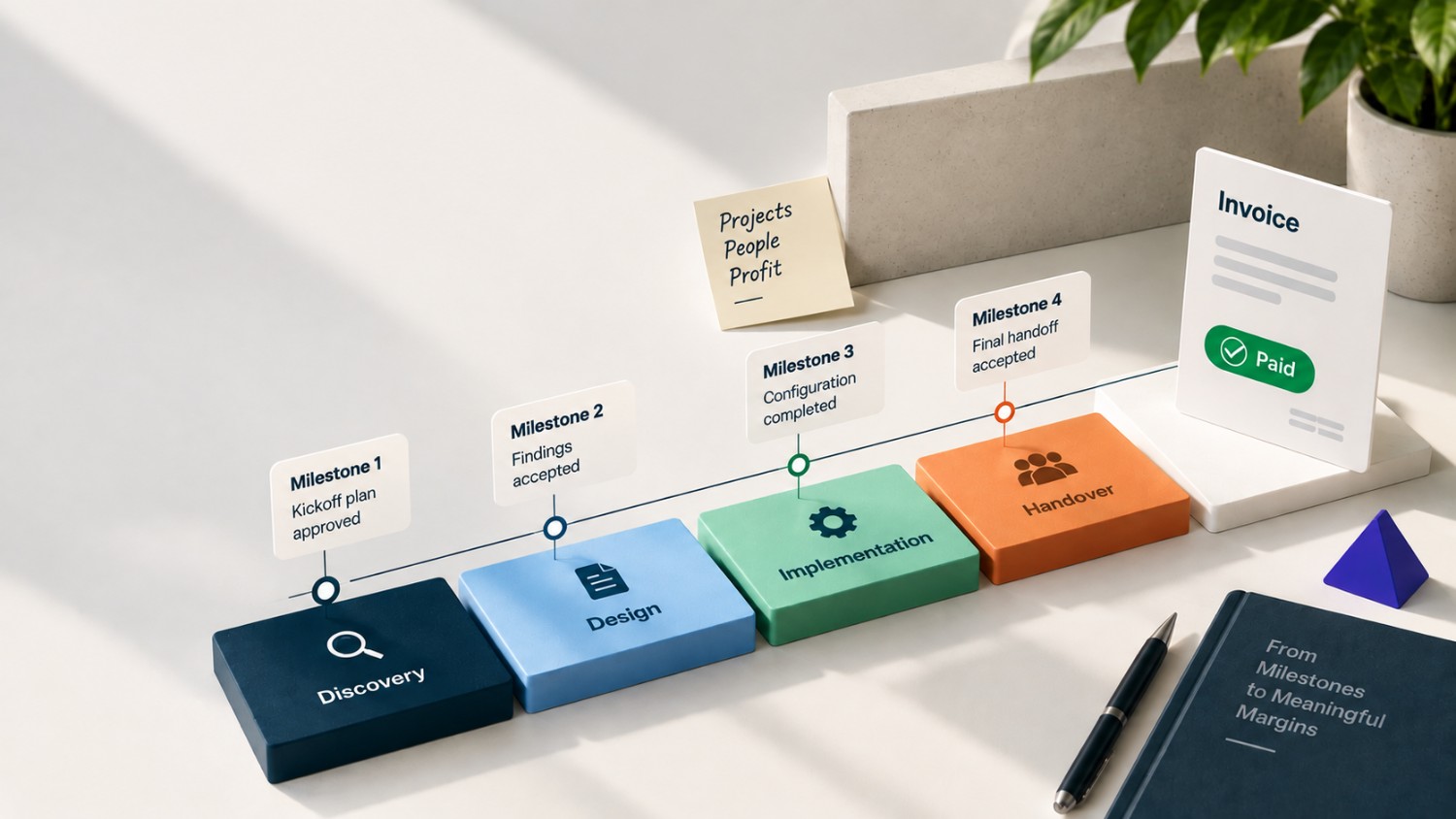
- Milestone billing ties invoices to predefined project events, deliverables, phases, or acceptance points rather than hours worked or recurring billing periods.
- It works best when deliverables and acceptance criteria are clearly defined, and both the client and delivery team can determine when a milestone has been reached.
- Milestone values should reflect expected labor cost, direct expenses, delivery risk, and cash exposure rather than automatically splitting the contract into equal payments.
- Time-based billing may be a better fit when effort is difficult to predict, while retainers suit recurring services and progress billing suits work that can be measured reliably by percentage complete.
- Changes in scope, staffing, timing, or dependencies can affect the cost and margin behind a milestone even when the invoice amount stays the same.
- Reaching a milestone does not guarantee the expected margin.
- You still need to monitor actual and forecast costs throughout delivery.
Milestone billing ties invoices to specific project stages rather than simply to hours worked or another month of service. A consulting firm might invoice after discovery is accepted, an IT services team after a migration goes live, or an engineering firm after a project phase is completed.
The model is attractive because it gives clients a clear connection between payment and progress, while allowing the firm to bill throughout the engagement. But the amount tied to each milestone is usually fixed in advance, even if the effort required to reach that milestone changes.
If a phase takes longer than expected, requires additional work, or is delayed by the client, the firm may incur more delivery costs without increasing the amount billed. The milestone can still be reached and invoiced as planned, while the margin on that phase declines.
The billing mechanics are straightforward. The more important management question is whether the milestone amounts still reflect the cost and scope of the work being delivered.
What Is Milestone Billing?
Milestone billing is a project billing method in which a client is invoiced when an agreed project event, deliverable, phase, or acceptance point is reached.
Rather than tying the invoice primarily to hours worked or the end of a service period, milestone billing is tied to progress against something the parties agreed in advance.
A milestone payment starts with a defined trigger.
The milestone usually begins in the statement of work or contract.
The parties agree on what must happen before they can issue an invoice. That could be delivering an assessment, approving a design, completing a successful migration, completing testing, or completing the final handoff.
A basic milestone definition should answer four questions:
- What has to be completed?
- What evidence shows that it is complete?
- Does the client need to approve or accept it?
- How much becomes billable when that happens?
Once the delivery team reaches the trigger and satisfies any required acceptance conditions, finance can issue the invoice according to the agreed payment terms.
The process becomes harder when delivery and finance do not share the same project information. The project manager may know the work is finished but still be waiting for formal acceptance, while finance may see only an uninvoiced milestone with a contractual date attached.
Accelo's project financial capabilities connect project delivery with budgets, billing, costs, and profitability so those conversations can happen from the same underlying project record rather than being reconstructed at invoice time.
Each milestone amount should reflect what it takes to reach that stage.
Consider a $200,000 implementation divided into four milestones:
The installments need not be equal, nor should symmetry be the objective.
If discovery requires several senior workshops, analysts, and substantial client coordination, while closeout requires relatively little labor, a 25/25/25/25 split may create an unnecessary cash gap even though it looks cleaner in the contract.
Before finalizing the payment schedule, compare the proposed invoice value with the expected cost of reaching each milestone. The firm should understand how much labor and direct cost it expects to carry before each invoice becomes available.
Billing milestones are not automatically revenue-recognition milestones.
The right to invoice and the timing of revenue recognition are related, but they are not interchangeable.
Under FASB ASC 606 and IFRS 15, revenue recognition depends on the contract, the underlying performance obligations, and when those obligations are satisfied.
A milestone may create an invoice without determining how or when to recognize the associated revenue for accounting purposes. Finance teams should follow the firm's accounting policies and professional guidance rather than treating the billing schedule as the revenue-recognition schedule.
When Should You Use Milestone Billing?
Milestone billing works best when the commercial structure matches how the project naturally progresses.
If the work has recognizable stages, each stage produces something the client can evaluate, and the cost of reaching those stages can be estimated with reasonable confidence, milestones can give both sides a clear payment structure.
Use milestone billing when deliverables have clear boundaries.
A strong milestone produces something the client can identify as complete.
That might be:
- A consulting assessment or recommendations package
- An approved engineering design
- A configured software environment
- Completion of a migration
- A completed audit phase
- An approved campaign launch
- Final testing and handoff
The milestone should be more specific than “Phase 1 complete.”
If discovery is complete only after a report has been delivered, two review cycles have been incorporated, and the project sponsor has approved the recommendations, put those conditions into the milestone.
That gives delivery a clear finish line and gives finance something defensible to invoice against. It also gives the firm a stronger reference point when the client asks for work outside the agreed phase.
Use milestone billing when extended projects create large gaps between cost and invoicing.
A six-month project billed entirely at completion forces the firm to carry months of labor and expenses before it invoices the client.
Milestones can reduce that gap by creating billing events as the work progresses. However, you should still test the schedule against the expected cost curve.
Suppose a project consumes 55% of its labor cost during the first two months but only 20% of the contract value becomes billable during that period. The project may eventually be profitable, but the firm is financing a larger share of the engagement than the contract value suggests.
Milestone billing works better when payment timing roughly follows the financial exposure required to reach each stage.
Use milestone billing when client acceptance aligns with natural project stages.
Many professional services projects already include formal or informal approval points.
An architecture client approves a design stage. A consulting sponsor signs off on recommendations. An IT team confirms that testing criteria have been met. An agency client approves campaign assets before launch.
Those can make good billing milestones because the delivery process already requires both sides to agree that the project has progressed.
Acceptance should still have boundaries. If the contract says payment depends on client approval but does not define the review period, an otherwise completed milestone can remain unbillable while feedback sits in someone's inbox.
Where appropriate, the SOW should specify who accepts the deliverable, how acceptance is recorded, the review period, and what happens if no response is received within that period.
When Another Billing Model May Work Better
Milestone billing is not inherently better than time-based billing, retainers, or progress billing. Each model allocates delivery and commercial risk differently.
The right choice depends on what the firm can define confidently before the work begins.
Use time-based billing when effort is more predictable than the deliverable.
Some work can be scoped directionally but not estimated tightly enough for a milestone price.
Suppose an implementation includes a data migration whose effort depends heavily on the quality of the client's source data. The desired outcome may be clear, but the team may not know whether reaching it will take 80 hours or 250.
A fixed milestone price transfers that uncertainty to the firm unless the contract clearly addresses the risk.
Time-based billing may be a cleaner commercial model until the uncertainty is reduced. The firm can still use budget caps, approval thresholds, and phase estimates to give the client cost control without pretending the effort is more predictable than it is.
Use a retainer when the client is buying recurring capacity or ongoing service.
Retainers work better when there is no meaningful project finish line every few weeks.
Ongoing advisory work, account management, optimization, support, and recurring marketing services often fit a monthly or quarterly fee because the client is buying continuing access or a defined level of service rather than a sequence of finite deliverables.
Problems arise when separate project work gets folded into the retainer without being scoped, priced, or billed separately.
For example, an agency may have a monthly retainer for ongoing campaign management, reporting, and optimization. Over time, the client may request marketing operations support or strategy work that wasn't part of the original scope. If you keep delivering that work within the same fee, the retainer can absorb substantially more capacity without generating additional revenue.
Keeping recurring services and out-of-scope project work separate makes each margin easier to understand.
Use progress billing when percentage complete is easier to measure than discrete events.
Progress billing invoices the client based on the portion of work completed rather than a specific milestone. It can work well for engagements that advance continuously and where percentage complete can be measured with confidence. The risk shifts from milestone timing to the accuracy of the completion estimate.
With milestone billing, the question is whether the agreed trigger has been reached. With progress billing, the question may become whether the project is truly 60% complete.
Whichever model you choose, the measurement method must be credible enough that the invoice doesn't become a negotiation every billing cycle.
How to Structure a Milestone Billing Schedule
A useful milestone schedule should give the client, delivery team, and finance team the same answer on what must happen before the next invoice becomes available.
That requires more than choosing four dates and splitting the contract value between them.
Tie each milestone to something the client can identify.
For each milestone, document the deliverable or event, expected completion date, invoice amount, owner, dependencies, acceptance criteria, and evidence required for invoicing.
For example:
The objective is not to create paperwork for its own sake. It is to remove enough ambiguity that the project manager and finance team do not have to reconstruct the engagement before every invoice.
Price milestones around expected effort, risk, and cash exposure.
Equal payment splits are easy to administer, but the effort and cost behind each phase are rarely equal.
Set milestone amounts with the expected labor cost, third-party spend, and delivery risk behind each billing event in mind. A technically complex implementation phase may justify more contingency than a routine handoff, while a milestone dependent on client approval may require different payment timing from one the firm largely controls.
If the project will incur $100,000 in cost before it can issue $60,000 in invoices, the payment schedule deserves another look, even if the overall contract margin still appears attractive.
Define how project changes affect the billing plan.
Not every change warrants a new invoice or change order, but the team should know where normal delivery tolerance ends. When scope, timing, resourcing, or dependencies materially change the effort or cost behind a milestone, assess the billing impact alongside the delivery impact.
Waiting until finance asks why a milestone has not been billed usually means the project has already carried the additional cost for too long.
Review milestone health before invoice day.
Invoice readiness should not first become visible at month-end.
A milestone review can sit inside the normal project cadence and answer a few practical questions:
- Does the milestone still reflect the current scope?
- Is the expected completion date realistic?
- Have any dependencies or acceptance conditions changed?
- Are actual and forecast hours still consistent with the milestone value?
- Is the evidence required for billing available?
- Has additional work been absorbed without a commercial adjustment?
- Does finance know what will become billable and when?
The answers connect delivery progress with work in progress (WIP), expected margin, and cash timing.
If the team cannot answer those questions without reconciling several spreadsheets and systems, the billing problem is partly a project-data problem.
Where Milestone Billing Breaks Down
A milestone can remain technically valid in the contract while becoming financially weaker during delivery. The most common problems involve scope, staffing, acceptance, and project cost.
Scope moves while the milestone stays the same.
Suppose discovery was priced around three stakeholder workshops and a recommendations package. During the phase, the client adds two regional workshops and asks for another analysis stream.
The team may decide the request is reasonable to accommodate, but the economics have changed. More labor is now required before the same discovery milestone can be billed.
Whether the firm issues a change order depends on the contract and the scale of the change, but the project forecast should be updated either way.
If the work keeps expanding while the milestone amount stays fixed, the project can absorb more cost without generating more revenue.
Resource changes can reduce margin without delaying the milestone.
A project can hit every milestone on time and still miss its expected margin.
Assume a $50,000 implementation milestone was priced around 180 consultant hours at an internal cost of $100 per hour and 30 senior hours at $180 per hour, plus $3,000 in direct expenses. Expected delivery cost is $26,400.
If a staffing constraint later shifts another 40 hours from the consultant to the senior resource, labor cost increases by $3,200 even though total hours stay the same.
The client still pays $50,000. The firm simply earns less margin on the milestone.
This is why milestone reviews need to look beyond completion status. The team should also understand whether the cost of reaching the milestone still aligns with the assumptions used to price it.
Late acceptance can move the rest of the project.
A phase may be complete from the delivery team's perspective, but the invoice may remain blocked because the client has not formally accepted it.
The immediate issue is cash timing, but acceptance delays can also affect the project plan.
People expected to move to the next phase may remain available for questions or rework. The next milestone shifts. A specialist scheduled on another engagement may suddenly have a conflict.
One delayed approval can start shifting staffing and delivery around it.
Clear acceptance rules reduce that ambiguity, while current schedule data helps the team understand how the delay affects later milestones.
Accelo's project management capabilities include project milestone tracking, client approvals, and AI-predicted completion dates, giving teams a view of both the planned milestone and where the work is now expected to finish.
Missing time can make fixed-fee work look healthier than it is.
Milestone billing does not make time capture irrelevant.
The client may not be paying by the hour, but the firm still needs to know how much labor it took to earn the milestone. If team members enter time late, the project can appear comfortably within budget even as the actual margin narrows.
That affects more than historical reporting. Incomplete time data can distort the remaining cost forecast and make a milestone appear more profitable than it is.
For fixed-fee and milestone work, time data shows whether the pricing model is working, even when it does not determine the invoice.
How PSA and AI Can Support Milestone Billing
Software does not fix a poorly structured milestone. It can, however, make it easier to see when the project starts moving away from the assumptions behind it.
Surface schedule risk before the invoice slips.
Milestone risk often appears upstream of the billing event.
A task slips, a dependency moves, or the resource scheduled to complete a critical activity becomes unavailable. The milestone date may still look intact until those smaller changes accumulate.
Accelo supports milestone tracking and AI-predicted completion dates, while its AI capabilities include predictive project risk flagging and early issue detection. Together, those signals can give the delivery team more time to investigate a likely delay before it affects the milestone or billing date.
Connect milestone progress with cost and margin.
Schedule status alone does not tell you whether the milestone is still financially on track.
Accelo's Project Financials connects project costs, billing, budgets, and margins, while Business Intelligence supports planned-versus-actual performance and margin analysis across projects to protect profitability.
The value is earlier context for the decision-maker. AI can flag a likely completion delay or margin issue; the project and financial owners can decide whether to change staffing, discuss scope with the client, adjust timing, or revise the billing plan.
Milestone Billing Works When the Billing Plan Moves With the Project
Milestone billing gives clients a clear connection between progress and payment, while giving professional services firms a way to invoice before a long engagement is complete.
It works best when billing events tie to deliverables the client can recognize, are priced around the cost and risk required to reach them, and are supported by clear acceptance rules.
The billing plan also needs to reflect material changes in scope, staffing, timing, or dependencies. Otherwise, the team can keep managing against assumptions that no longer match the work being delivered.
A milestone is most useful when delivery and finance can see the same event from both sides: what's been completed and what it cost to get there. Accelo connects project management, project financials, and business intelligence so the billing view can stay connected to the work behind it. Book a Demo to learn more.
Frequently Asked Questions
What is milestone billing?
Milestone billing means invoicing a client when a predefined project event, deliverable, phase, or acceptance point is reached. The contract typically defines the billing trigger, invoice amount, and any completion or acceptance requirements.
How does milestone payment work?
The client and firm agree on project milestones and the amount payable at each one. When the defined work is complete and any required acceptance conditions are satisfied, the firm invoices the agreed amount under the contract's payment terms.
What is a milestone payment?
A milestone payment is an agreed payment tied to completing a specific project stage, event, or deliverable. The amount is generally based on reaching the milestone rather than the number of hours used to complete it.
What does it mean to be paid by milestone?
Being paid by milestone means invoices are due when agreed project stages are completed, rather than solely based on hours worked or a recurring billing period.
What is the difference between progress billing and milestone billing?
Progress billing generally invoices based on a measure such as the percentage of work completed. Milestone billing invoices when a predefined event or deliverable is reached. One depends on measuring progress; the other depends on meeting a specific trigger.
When is milestone billing better than time-based billing?
Milestone billing is a strong fit when the deliverables and completion criteria can be defined clearly, and the firm can estimate the effort with reasonable confidence. Time-based billing is usually better when scope or required effort is likely to change significantly during delivery.
What should a milestone billing schedule include?
A milestone billing schedule should identify the billing event, deliverable, planned date, invoice amount, owner, completion or acceptance criteria, required evidence, dependencies, and the process for handling material scope or timing changes.




.svg)



.svg)