Overview
- Billable hours are the hours your team spends delivering work that can be invoiced to a client.
- Non-billable hours support your business but cannot be charged directly to clients.
- Accurately tracking billable and non-billable hours helps professional services organizations improve profitability, forecast revenue, price work more effectively, and understand how team time is spent.
What Are Billable Hours?
Billable hours are the time employees spend performing work that can be charged directly to a client, and are the primary source of revenue for professional services organizations.
Billable work is typically defined in a contract, a statement of work (SOW), a retainer agreement, or another client engagement. When a consultant, designer, developer, engineer, or project manager performs work covered by that agreement, those hours are recorded and later invoiced to the client.
Examples of billable hours include:
- Client meetings
- Consulting and advisory work
- Project planning and delivery
- Design and creative production
- Software development or implementation
- Engineering work
- Client revisions
- Research performed for a client project
- Support services covered under contract
While billable hours are an important financial metric, they represent only part of the work required to operate a successful professional services business.
What Are Non-Billable Hours?
Non-billable hours are the time employees spend on activities that cannot be invoiced to a client. Although they don't generate revenue directly, they are necessary to support operations, develop employees, win new business, and improve service delivery.
Common examples of non-billable hours include:
- Internal meetings
- Business development and sales
- Marketing activities
- Employee training
- Administrative work
- Recruiting and interviewing
- Company events
- Paid time off and holidays
- Internal planning and process improvement
Tracking non-billable work is just as important as tracking billable work. It helps organizations understand where time is being invested and identify opportunities to improve efficiency without sacrificing activities that support long-term growth.
Billable vs. Non-Billable Hours
Both types of work are essential to the organization. Billable hours generate revenue, while non-billable hours keep the business running, support employee development, and create future opportunities.
Why Billable Hours Matter
For organizations that sell expertise, billable hours directly influence revenue and profitability.
Accurate billable hour tracking helps organizations:
- Invoice clients correctly
- Improve project budgeting and estimating
- Forecast future revenue
- Understand project profitability
- Compare planned versus actual effort
- Identify opportunities to improve operational efficiency
Just as importantly, tracking all hours—not only billable work—provides a more complete picture of team capacity and business performance. If employees spend more time than expected on internal meetings, administrative tasks, or rework, leaders can identify these trends and make informed operational decisions.
How to Calculate Billable Hours
Calculating billable hours begins with tracking the amount of time spent on client work.
The basic formula is:
Total Billable Hours = Total Hours Worked − Non-Billable Hours
For example, if an employee works 40 hours during a week and spends:
- 30 hours on client projects
- 6 hours in internal meetings
- 2 hours on training
- 2 hours on administrative tasks
Their billable hours for the week would be 30 hours.
Most professional services organizations track billable hours using project management or Professional Services Automation (PSA) software, which records time against specific projects, clients, and tasks while simplifying invoicing and reporting.
How Many Billable Hours Are in a Year?
Most full-time professional services employees have approximately 2,080 available working hours each year before accounting for time off, training, meetings, and other non-billable activities. The actual number of billable hours varies by organization, role, and utilization expectations. Annual billable hours vary based on:
- Vacation and paid time off
- Public holidays
- Training
- Internal meetings
- Administrative responsibilities
- Business development
- Your organization's target utilization
A simple way to estimate annual billable hours is:
Working Days × Hours per Day = Available Working Hours
Then subtract:
- Vacation
- Holidays (vary by region; assume 10 as a baseline average)
- Training
- Internal meetings
- Other non-billable activities
For example:
- 260 working days per year (52 weeks * 5 days/week)
- × 8 hours per day
- = 2,080 available hours
Subtract:
- 15 vacation days (120 hours)
- 10 public holidays (80 hours)
- 40 hours of training
- 120 hours of meetings and administration (about 2.5 hours/week)
Available billable time = 1,720 hours
Every organization will have a different number of billable hours available per employee. The estimate depends on factors such as PTO policies, training requirements, roles and internal responsibilities, and the time employees spend on non-billable work.
Best Practices for Tracking Billable Hours
Organizations that consistently invoice accurately and forecast revenue effectively typically follow a few simple practices:
- Record time daily instead of waiting until the end of the week.
- Track both billable and non-billable work.
- Use consistent project and task categories.
- Review time entries regularly for accuracy.
- Compare estimated hours with actual hours to improve future planning.
- Use PSA software to automate time tracking, invoicing, and reporting.
Small improvements in time tracking lead to more accurate invoices, better project estimates, and stronger financial visibility.
Common Billable Hour Tracking Mistakes
Even organizations with mature delivery processes lose billable revenue through inconsistent time tracking. The biggest issue often isn't whether employees track their time; it's when they track it.
The longer someone waits to record their work, the more likely they are to forget small client interactions, underestimate time spent, or misclassify billable work. Individually, those missed minutes may seem insignificant. Across an entire organization, they can add up to substantial revenue leakage.
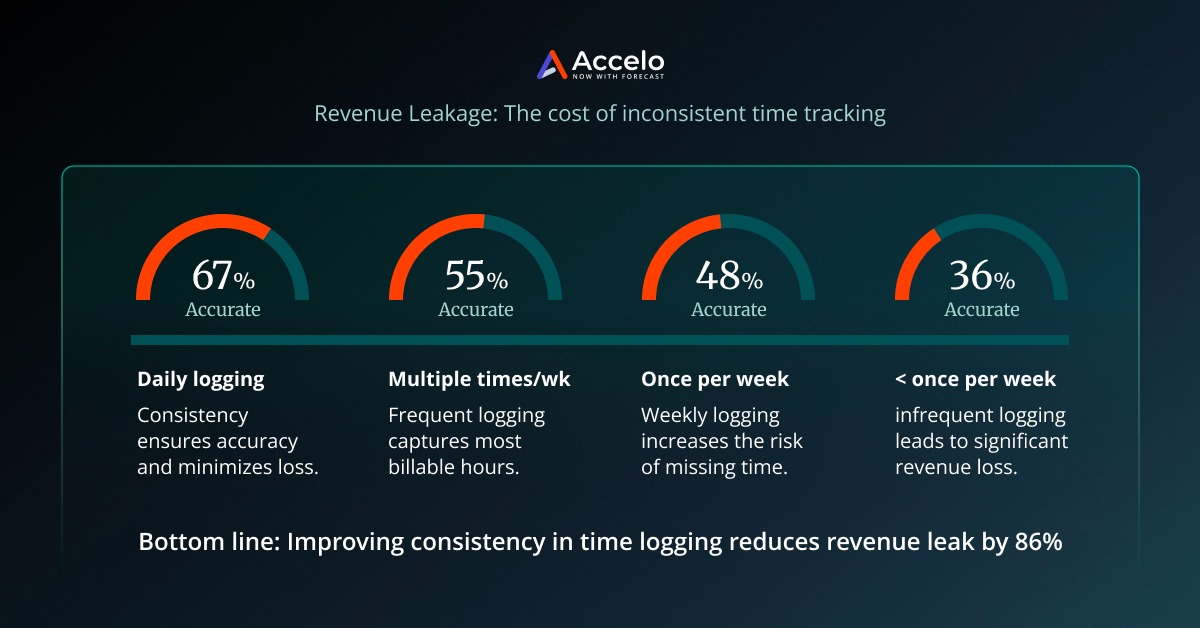
Research shows that time entry accuracy declines dramatically as logging becomes less frequent:
- Daily time logging: 67% accurate
- Multiple times per week: 55% accurate
- Once per week: 48% accurate
- Less than once per week: 36% accurate
As accuracy decreases, organizations risk underbilling clients, reducing project profitability, and making decisions based on incomplete data.
Improving the consistency of time tracking can reduce revenue leakage by up to 86%.
Common billable hour tracking mistakes include:
- Waiting until the end of the week to enter time
- Forgetting short client calls, emails, or meetings
- Recording time against the wrong project or client
- Misclassifying billable work as non-billable
- Relying on spreadsheets or disconnected systems instead of centralized time tracking
The most effective organizations make time tracking part of the daily workflow, ensuring billable hours are captured accurately while providing reliable data for invoicing, forecasting, project management, and profitability reporting.
Billable Hours vs. Utilization
Billable hours and utilization are closely related, but they measure different things.
Billable hours measure the amount of client work performed.
Utilization measures what percentage of an employee's available working time is spent on billable work.
For example, an employee who records 30 billable hours during a 40-hour workweek has a utilization rate of 75%.
While billable hours help organizations understand revenue generation, utilization provides additional insight into workforce efficiency and capacity planning. Learn more in our guide to Resource Utilization.
How Accelo Helps You Capture More Billable Hours
Tracking billable hours is only valuable if that time is captured accurately and flows seamlessly into your project and financial processes. Many professional services organizations still rely on spreadsheets, disconnected time trackers, or manual invoicing, increasing the risk of missed billable work and revenue leakage.
Accelo's Professional Services Automation (PSA) software helps organizations improve billable-hour management by connecting time tracking, project delivery, and invoicing in a single platform. Teams can:
- Automatically capture billable client work through integrated email and activity tracking
- Connect time entries directly to projects, retainers, and client invoices
- Compare estimated versus actual hours in real time
- Identify revenue leakage before it impacts profitability
- Generate invoices from approved time entries, reducing manual administration and billing delays
By giving organizations a complete view of time, projects, resources, and financials, Accelo helps ensure more of the work your team performs is accurately tracked, billed, and converted into revenue. Learn how Accelo's PSA platform simplifies time tracking, project management, and billing; book a demo now.
Frequently Asked Questions
What are billable hours?
Billable hours are the hours spent performing work that can be invoiced directly to a client under a contract, project, or retainer agreement.
What are non-billable hours?
Non-billable hours include internal work such as meetings, training, administration, marketing, recruiting, and other activities that support the business but cannot be charged to clients.
What counts as billable work?
Billable work typically includes consulting, implementation, design, engineering, project delivery, client meetings, contracted support, and other work performed specifically for a client engagement.
How many billable hours are in a year?
The number varies by organization. After accounting for vacation, holidays, training, meetings, and other non-billable activities, many professional services organizations have approximately 1,400–1,700 billable hours available per employee each year.
Why should organizations track non-billable hours?
Tracking non-billable hours helps organizations understand where employee time is being spent, improve forecasting, identify operational inefficiencies, and make more informed staffing decisions.
What happens if you don't track billable hours accurately?
When billable time isn't recorded accurately, organizations often invoice less than they've earned, underestimate the true cost of delivering projects, and make business decisions based on incomplete data. Even small gaps in time tracking can compound over hundreds of projects, leading to revenue leakage, lower profitability, and less reliable forecasting. Recording time consistently—ideally every day—helps ensure client work is captured, billed, and reported accurately.
Are client meetings billable?
Yes. If a client meeting is part of a contracted engagement or project, it is typically considered billable. Internal meetings, however, are generally non-billable.

.svg)