Utilization rate measures how much of an employee's available working time is spent on billable client work. For professional services organizations, it's one of the most important performance metrics because it directly affects revenue, profitability, staffing decisions, and future growth.
A strong utilization rate means your team is spending more time delivering value to clients and less time sitting on the bench or performing non-billable work. But like most business metrics, higher isn't always better. The goal isn't to keep everyone busy every minute of the day—it's to maintain a healthy balance that supports profitability, quality work, and sustainable growth.
What Is Utilization Rate?
Utilization rate is the percentage of an employee's available working hours that are spent performing billable work for clients.
Unlike simple productivity metrics, utilization measures whether your team's time is generating revenue. It helps professional services organizations with capacity planning and resource management, enabling team leaders to understand whether they have too much capacity, too little capacity, or the right balance of work across their teams.
For example, if a consultant is available to work 160 hours during a month and spends 120 of those hours on billable client work, their utilization rate is 75%.
Because labor is typically the highest cost in a professional services business, utilization is one of the clearest indicators of operational efficiency and financial performance.
How do your utilization rates compare to industry averages? Find out.
Why Utilization Rate Matters
Every unbilled hour represents capacity that can't be recovered. While some non-billable work is necessary, such as training, internal meetings, business development, or administrative tasks, consistently low utilization often signals opportunities to improve planning, staffing, or project delivery.
Monitoring utilization helps organizations:
- Increase profitability
- Improve resource planning
- Balance workloads across teams
- Forecast hiring needs
- Identify excess capacity before it becomes expensive
- Make better project staffing decisions
- Confidently take on new work, knowing your team can deliver
Even small improvements can have a significant financial impact. According to SPI Research, a 1% increase in utilization can improve operating profit by up to 20%.
A 1% increase in utilization can improve operating profit by up to 20%
How to Calculate Utilization Rate
The utilization rate formula is straightforward:
Utilization Rate = (Billable Hours ÷ Available Hours) × 100
For example, a consultant works:
- Available hours: 160
- Billable hours: 120
Calculation:
120 ÷ 160 × 100 = 75% utilization
The key is using available working hours, not total calendar hours. Available hours typically exclude holidays, vacation, and other planned time away from work. Read more about billable hours. Establishing that number for a whole team is a separate exercise, covered in how to calculate resource capacity from net available hours.
Billability vs. Utilization: What's the Difference?
Billability and utilization are closely related, but they measure different things. Billability describes the work itself, while utilization measures how effectively your available workforce is being used.
What Is a Good Utilization Rate?
A good utilization rate isn't simply "the higher, the better." The healthiest professional services organizations operate in what many leaders call the utilization Goldilocks zone: not too low, not too high—just right.
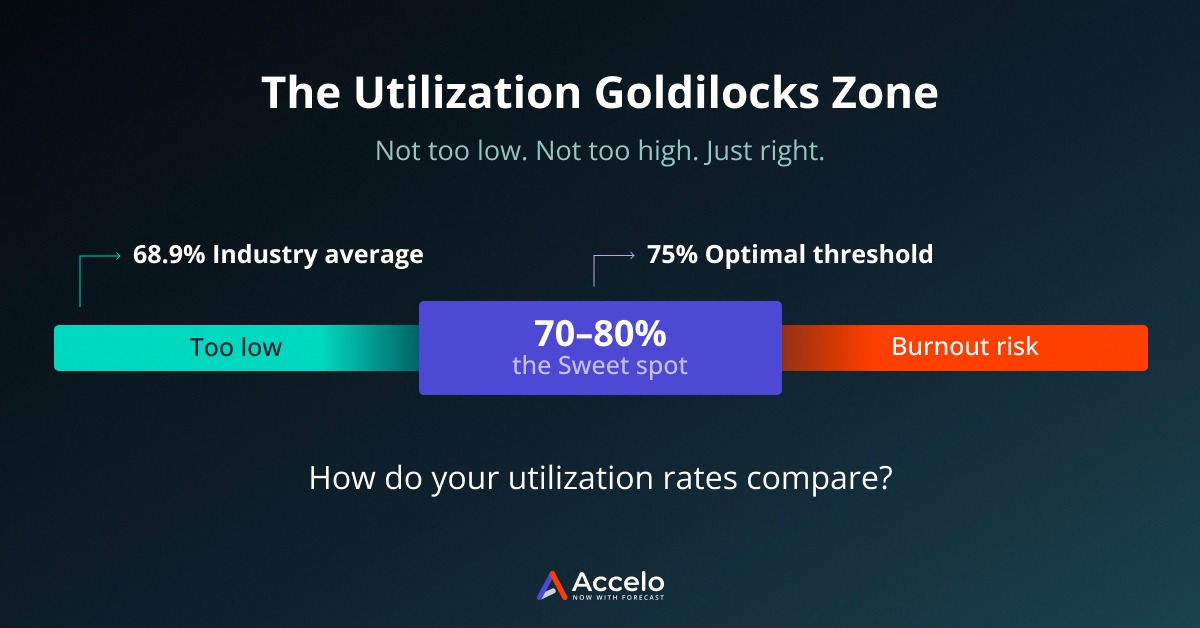
For most consulting firms, agencies, IT services organizations, and other professional services businesses, that sweet spot falls between 70% and 80% utilization, with 75% often cited as the ideal target.
Below this range, consultants may be underutilized, leaving billable capacity—and revenue—on the table. Above it, teams may appear highly productive, but sustained utilization above 80% often leads to burnout, reduced quality, missed internal work, and little flexibility to absorb new projects or unexpected client requests.
The goal isn't to maximize utilization. It's to optimize it. The most profitable organizations maintain enough billable work to keep people productive while preserving the capacity needed for training, collaboration, innovation, business development, and the inevitable changes that occur during project delivery.
It's also important to remember that not every employee should have the same utilization target.
Project managers, sales teams, executives, customer success, and operational staff naturally spend more time on non-billable activities than consultants or delivery teams. Comparing everyone against the same benchmark can produce misleading conclusions.
READ NEXT: Resource Utilization in the Age of AI: A New Approach to Capacity Management
What Is Underutilization?
Underutilization occurs when employees have available capacity but aren't spending enough of their time on productive, billable work.
This doesn't necessarily mean employees aren't working hard. Instead, underutilization often reflects operational challenges elsewhere in the business.
Common causes include:
- Poor resource planning
- Inaccurate demand forecasting
- Scheduling gaps between projects
- Weak sales pipeline
- Too much administrative work
- Skills that don't align with current project demand
Persistent underutilization increases labor costs without generating additional revenue, reducing profitability over time.
What Does Underutilized Mean in Professional Services?
An underutilized employee is someone whose available working capacity isn't being fully used on productive or revenue-generating work.
For example, a consultant who is available for 40 hours during the week but only bills 18 hours to client projects is considered underutilized.
Being underutilized doesn't necessarily reflect poor individual performance. More often than not, it's a sign that project scheduling, forecasting, sales activity, or resource allocation needs improvement.
What Happens When Utilization Rates Are Too Low or Too High?
Healthy utilization is about balance. Both extremes can create problems.
When utilization rates are too low, organizations may experience:
- Lost revenue opportunities
- Idle resources
- Lower profitability
- Overstaffing
- Inaccurate hiring decisions
When utilization rates are too high, they can lead to:
- Employee burnout
- Project delays
- Quality issues
- Staff turnover
- Difficulty responding to new client work
The most successful professional services organizations don't simply maximize utilization; they optimize it by balancing profitability with sustainable delivery.
How to Improve Utilization Rate
Improving utilization isn't about asking employees to work longer hours; it's about making better use of the capacity you already have.
Some of the most effective strategies include:
- Improve demand forecasting
- Use placeholder scheduling to book resources earlier
- Balance workloads across teams
- Reduce administrative overhead
- Encourage consistent time tracking
- Monitor utilization regularly instead of waiting until month-end
- Use integrated resource planning and project management software
Organizations that monitor utilization continuously can make better resourcing decisions, keep projects on track, and protect profitability by addressing issues before they escalate.
Improve Your Utilization Rates with Accelo
"Shortly after implementing Accelo, we improved our utilization rates from 35% to 85%. Our budget and profit per job are all very accurate now, and we make better business decisions as a result." - Martin Gamble, Gamcorp (Australia)
Tracking utilization in spreadsheets quickly becomes difficult as projects, people, and client demands grow. Without real-time visibility, managers often discover underutilized resources—or overloaded ones—only after revenue or project performance has already been affected.
Accelo helps professional services organizations improve utilization by unifying project management, resource scheduling, time tracking, financials, and forecasting on a single AI-powered platform. Managers can see team capacity in real time, identify underutilized resources, use AI-assisted resourcing to rebalance workloads, and see future capacity needs using AI-powered, pipeline-weighted forecasting.
"Accelo feels like it was made for agencies. I've worked across several, all with different models — and out of the box, Accelo just works. Our billable utilization is up 25%, and our team is hitting their targets." - Joanne Reid, Remarkable Group (United Kingdom)
Ready to improve your utilization and profitability? Book a demo to see how Accelo helps professional services teams plan smarter, optimize resources, and deliver more profitable work.
Frequently Asked Questions
What is utilization rate?
Utilization rate measures the percentage of an employee's available working time spent performing billable client work.
How do you calculate utilization rate?
Divide billable hours by available working hours and multiply by 100.
Utilization Rate = (Billable Hours ÷ Available Hours) × 100
What is a good utilization rate?
Many professional services organizations target 75%-85% utilization for billable consultants, although ideal rates vary by role.
What's the difference between utilization and billability?
Billability measures whether specific work can be charged to a client. Utilization measures the percentage of an employee's available time spent on billable work.
What does underutilized mean?
An underutilized employee has available capacity that isn't being used on productive or billable work. This is often caused by scheduling, forecasting, or resource planning issues rather than individual performance.
Can utilization ever be too high?
Yes. Consistently high utilization can lead to employee burnout, lower quality work, project delays, and limited flexibility to take on new client work.
Why is utilization important in professional services?
Because labor is the primary cost for most professional services organizations, utilization directly affects profitability, staffing decisions, forecasting accuracy, and long-term business performance.

.svg)