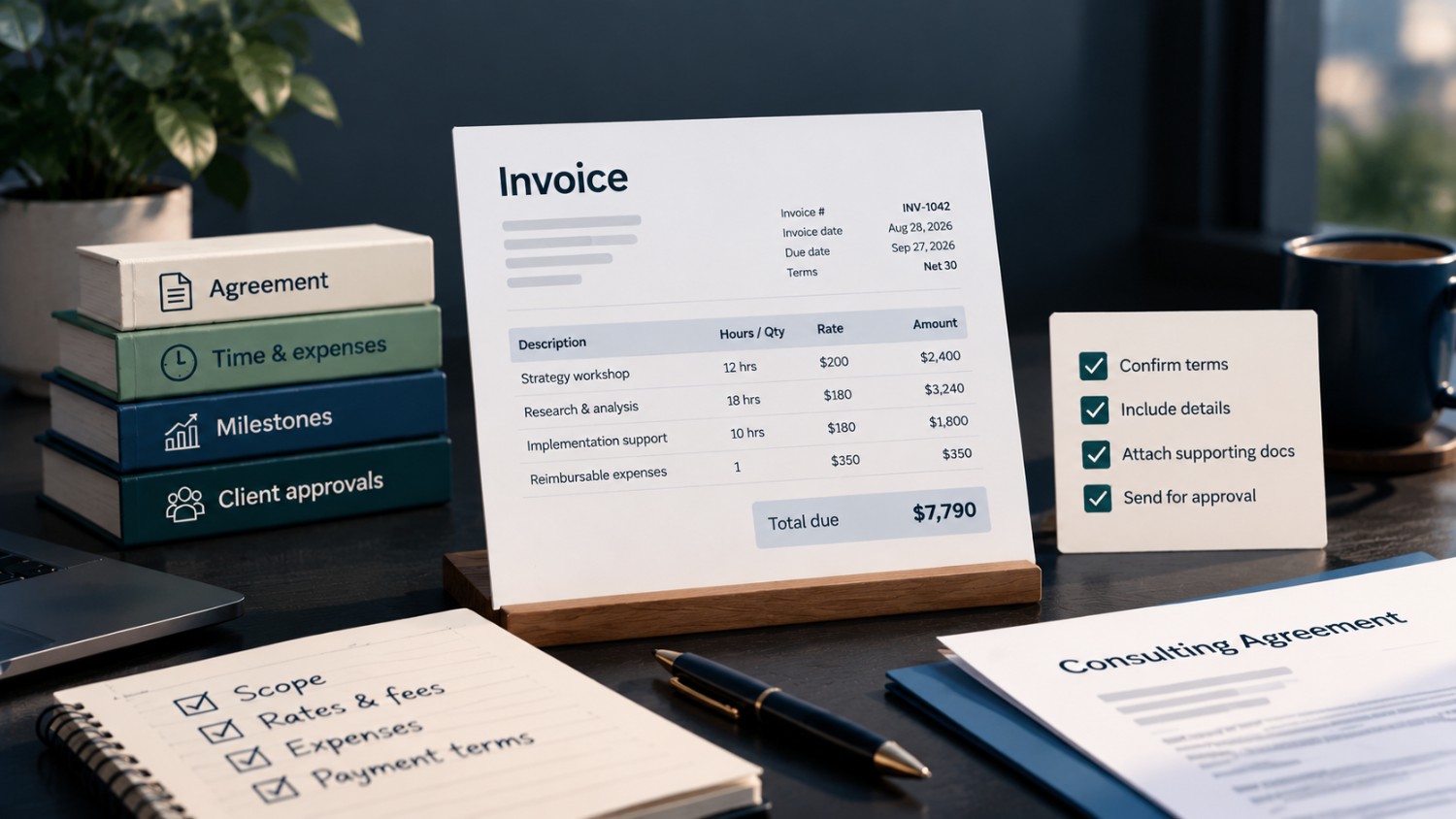
Consulting invoices have to do more than show an amount due. They need to connect the work performed to the terms the client already agreed to, with enough detail for the invoice to move through approval without unnecessary questions or delays.
To invoice for consulting services, start with the signed agreement. Confirm what is billable, what triggers the invoice, the billing period or milestone being invoiced, applicable rates or fees, reimbursable expenses, taxes, payment terms, and any documentation the client requires for approval.
The invoice itself will look different depending on whether the engagement is billed by milestone, time and materials, retainer, or another agreed structure.
Key Takeaways
- Start with the signed agreement: confirm the billing trigger, scope, rates or fees, expense rules, approval requirements, and payment terms.
- Milestone invoices should identify the agreed project event or deliverable and include any evidence required for acceptance.
- Time-and-materials invoices should show approved hours, contracted rates, work performed, reimbursable expenses, and the billing period.
- Many invoice problems begin before billing, particularly when time, scope changes, expenses, or approvals are incomplete.
- Keeping project delivery and financial records connected reduces reconciliation and makes invoices easier to prepare and approve.
What Should a Consulting Invoice Include?
A consulting invoice should give the client enough information to understand what is being billed, connect it to the agreement, and approve it without unnecessary back-and-forth.
Client, Firm, and Invoice Details
Include the identifiers the client's finance or procurement team uses to route and approve the invoice:
- Your consulting firm's legal name and contact information
- The client's legal name and billing contact
- Invoice number
- Invoice date
- Due date
- Purchase order number, if required
- Project, engagement, or statement of work reference
These details may seem administrative, but missing identifiers can delay an otherwise accurate invoice.
Scope, Service Period, and Billing Structure
State the engagement name and identify exactly what the invoice covers.
For milestone billing, name the milestone, phase, deliverable, or other payment event. For time-and-materials billing, identify the billing period and the work performed during that period.
Retainers require different controls around recurring service periods, available hours or services, rollover policies, and usage. For more on that structure, see how to manage retainer invoices and this guide to consulting retainers.
Rates, Fees, Expenses, Taxes, and Payment Terms
The financial details on the invoice should reflect the agreement.
Depending on the billing model, that can include:
- Role-based or individual rates
- Fixed milestone or phase fees
- Approved reimbursable expenses
- Applicable taxes
- Credits or previously approved adjustments
- Total amount due
- Accepted payment methods
- Payment due date
Common payment terms include due upon receipt, Net 15, Net 30, deposits, and progress payments. Whatever the structure, the invoice should reflect the terms already established in the client agreement.
Supporting Documentation
Include the documentation the client requires to approve payment. Depending on the engagement, that may include:
- Approved timesheets
- Milestone acceptance or sign-off
- Deliverable approval
- Expense receipts
- Approved change requests
- Brief work summaries or status documentation
If project, accounting, payment, and document systems are separate, make sure the required billing records can move between them without losing approvals, expense details, or project references.
How to Invoice Consulting Services Step-by-Step
The invoice should be the final output of the billing process, not the point where finance starts reconstructing what happened during the engagement.
1. Confirm the billing trigger.
Start with the contract, statement of work, purchase order, or other governing agreement.
Confirm what makes the work billable. Depending on the engagement, the trigger may be:
- Completion of an agreed milestone
- Client acceptance of a deliverable
- The end of a weekly or monthly billing period
- Approved hours worked
- A scheduled progress payment
- Another contract-defined event
Do not assume the project team's definition of “complete” automatically matches the client's payment terms.
2. Confirm what work is approved for billing.
Before preparing the invoice, reconcile the work performed with the scope and billing rules.
For time-and-materials work, confirm that billable time has been submitted, reviewed, and categorized correctly.
For milestone work, confirm that the milestone has met any required acceptance criteria and that the supporting approval is documented.
If work has been added or changed since the original agreement, determine whether the change has been approved for billing before including it.
3. Reconcile time, expenses, and scope changes.
Check for billable activity that may not yet be reflected in the billing record.
That can include:
- Client calls
- Email-based consulting work
- Additional workshops
- Implementation support
- Approved travel or other expenses
- Changes in project scope
- Additional deliverables requested during the engagement
Missing records at this stage can result in underbilling, delayed invoices, or disputes after the invoice reaches the client.
4. Build the invoice around the agreed billing structure.
The line items should mirror how the client agreed to pay.
A milestone invoice should emphasize the completed billing event and agreed fee.
A time-and-materials invoice should emphasize approved effort, rates, and reimbursable costs.
Avoid adding detail simply because the system can produce it. The client needs enough information to verify the charge, not a transcript of every activity performed.
5. Attach the required evidence.
Check the client's approval requirements before sending the invoice.
Some clients may only require a project or PO reference. Others may expect signed milestone approvals, timesheets, expense receipts, or work summaries.
An accurate invoice can still be delayed if the required approval documentation is missing.
6. Review the invoice against the agreement.
Before sending it, verify:
- Billing period or milestone
- Contracted rates or fees
- Billable hours
- Approved expenses
- Tax treatment
- Purchase order details
- Payment terms
- Due date
- Supporting documentation
- Any approved adjustments or credits
This review is also an opportunity to catch work that was performed but never recorded or scope changes that still require approval.
7. Send the invoice and track payment.
Send the invoice to the correct billing contact and monitor its status through approval and payment.
If the client's finance team raises a question, the project and billing records should let you answer it without rebuilding the engagement history from email, spreadsheets, and individual timesheets.
How Does Invoicing Change by Billing Model?
Once the billing model is established in the agreement, the invoice needs to reflect how the client has agreed to pay. The biggest differences are the billing trigger, line-item detail, and supporting evidence.
Invoicing Milestone-Based Consulting Work
For milestone-billed work, issue the invoice when the contract-defined billing event occurs.
The invoice should typically identify:
- Milestone, phase, or deliverable
- Completion or billing date
- Agreed milestone fee
- Approved reimbursable expenses
- Applicable taxes
- Payment terms
- Required acceptance or completion evidence
The key is traceability. The client should be able to connect the invoice directly to the event defined in the agreement.
Milestone billing can be useful for consulting engagements with clearly defined project stages, but the financial management behind it deserves separate attention. See how milestone billing works for a deeper look at acceptance criteria, milestone structure, scope changes, and margin risk.
Invoicing Time-and-Materials Projects
For time-and-materials work, invoice the approved effort incurred during the billing period.
The invoice should typically include:
- Role or consultant
- Approved hours
- Contracted rate
- Billing period
- Concise description of work performed
- Approved reimbursable expenses
- Applicable taxes
- Supporting time records when required
Late or incomplete time records can affect both billing accuracy and approval speed. Billable work that was performed but never recorded may never make it into the invoice.
Milestone vs. Time-and-Materials Invoicing
For a broader overview of the different ways professional services organizations structure client billing, see this guide to project billing.
Consulting Invoice Examples
Consider a consulting firm delivering a process improvement engagement that includes discovery, stakeholder interviews, current-state assessment, future-state workflow design, implementation support, and final recommendations.
The work itself may be similar under either billing model. What changes is how the invoice is triggered and structured.
Sample Milestone Invoice
Assume the engagement is divided into three contract-defined milestones:
- Milestone 1: Discovery and current-state assessment — Agreed fee: [amount]
- Milestone 2: Future-state workflow design — Agreed fee: [amount]
- Milestone 3: Implementation support and final handoff — Agreed fee: [amount]
- Approved reimbursable expenses: Agreed fee: [amount]
The invoice should also reference the applicable milestone completion date, statement of work or contract section, payment terms, total due, and any acceptance evidence the client requires.
If the project team already tracks milestone status in a project management system, finance should use that record rather than reconstructing completion from email threads.
Sample Time-and-Materials Invoice
The same engagement under a time-and-materials agreement could be invoiced by role:
- Principal consultant: [hours] × [contracted hourly rate]
- Senior consultant: [hours] × [contracted hourly rate]
- Analyst: [hours] × [contracted hourly rate]
- Approved reimbursable expenses: [amount]
Work descriptions might include stakeholder interviews, workflow mapping, implementation support, or executive readout preparation.
The client needs enough detail to approve the invoice, not a diary of every task.
Billing Gaps That Result in Delays or Lost Revenue
Many invoicing problems begin before finance prepares the invoice. Missing time, undocumented scope changes, incomplete approvals, and unrecorded reimbursable expenses can all affect what gets billed or how quickly the client can approve it.
Missing Billable Time
Client calls, emails, reviews, and last-minute delivery support are easy to miss when time is entered late or reconstructed from memory.
For time-and-materials work, missing billable time can understate reported utilization and reduce the amount ultimately invoiced.
For fixed-fee or milestone work, incomplete time records can hide the actual cost of delivery and distort project margin.
Unapproved Scope Changes
Consulting engagements change. A client requests another workshop, an executive sponsor asks for a revised deliverable, or implementation requires work that was not anticipated in the original scope.
The billing problem begins when the team performs that additional work without documenting whether it changes the fee, hours, budget, or delivery commitment.
When scope changes are not recorded and approved, the firm may absorb work it intended to bill or create a dispute when additional charges appear on the invoice.
Milestones Without Acceptance Evidence
A milestone invoice may be accurate and still be delayed if the client's finance or procurement team cannot verify that the billing trigger was met.
Deliverables sent through email, verbal approvals, or status updates kept outside the project record make that review harder than it needs to be.
The problem is not the invoice format. It is the missing approval trail.
Expenses Without Supporting Detail
Reimbursable expenses should follow the agreement: what qualifies, whether preapproval is required, and what documentation the client expects.
Establish those requirements before expenses begin accumulating rather than trying to determine them when the invoice is ready to go out.
How Can Consulting Firms Make Invoicing Easier to Manage?
The cleanest billing processes connect the information behind the invoice rather than treating invoicing as a separate administrative step.
Scope, rates, project delivery, time, expenses, approvals, billing, and payment status all affect whether the invoice is correct and how quickly it can be approved.
Accelo connects those records across the professional services lifecycle. Project plans, time records, rate cards, expenses, billing milestones, and project financials stay tied to the client work that generated them rather than being reconciled manually at billing time.
Accelo also surfaces missing time, inconsistencies in project data, and emerging profitability risk earlier in the delivery process, giving teams a chance to correct the underlying records before the invoice is prepared.
For firms that use separate accounting software, Accelo's integrations connect project and billing workflows with systems such as QuickBooks Online and Xero, reducing the handoffs between delivery and accounting.
The effect can be substantial when billing has become heavily manual. Marcussen Consulting reduced its monthly invoicing process from six days to one after moving its workflow into Accelo, saving approximately 40 hours per month.
Make the Invoice the End of the Process, Not the Start
A consulting invoice should not require finance to reconstruct the engagement.
When scope, time, expenses, milestones, approvals, and billing terms stay current throughout delivery, preparing the invoice becomes a verification step rather than a research project.
Accelo connects project and financial records to invoicing, so consulting firms can move from completed work to an accurate invoice with less reconciliation. Book a demo to see how it works.
Frequently Asked Questions
What should a consulting invoice include?
A consulting invoice should include firm and client details, invoice number, billing period or milestone, scope, rates or fees, approved expenses, applicable taxes, payment terms, due date, and any supporting documentation required for approval.
How do I write an invoice for consulting services?
Start with the signed agreement, confirm what is billable, and identify the billing trigger. Then list the applicable milestone, service period, hours, rates or fees, approved expenses, taxes, payment terms, and supporting documentation.
How does invoicing differ for milestone and time-and-materials consulting?
Milestone invoices are triggered by an agreed project event, phase, or deliverable. Time-and-materials invoices are based on approved hours, contracted rates, and reimbursable costs incurred during the billing period.
When should a consultant send a milestone invoice?
Send a milestone invoice when the billing trigger defined in the agreement occurs. That may be deliverable acceptance, phase completion, formal sign-off, a scheduled payment date, or another agreed project event.
How detailed should a time-and-materials invoice be?
Include enough detail for the client to verify and approve the charge: billing period, consultant or role, approved hours, contracted rate, concise description of work performed, reimbursable expenses, and supporting records when required.
What payment terms should consultants use?
Use the payment terms established in the signed agreement. Common structures include due upon receipt, Net 15, Net 30, deposits, and progress payments. The invoice should clearly repeat the due date and accepted payment methods.
How can consulting firms avoid missing billable work?
Keep time, scope changes, expenses, and approvals current throughout delivery rather than reconstructing them at billing time. Regular review makes it easier to identify billable work before the invoice is finalized.




.svg)



.svg)