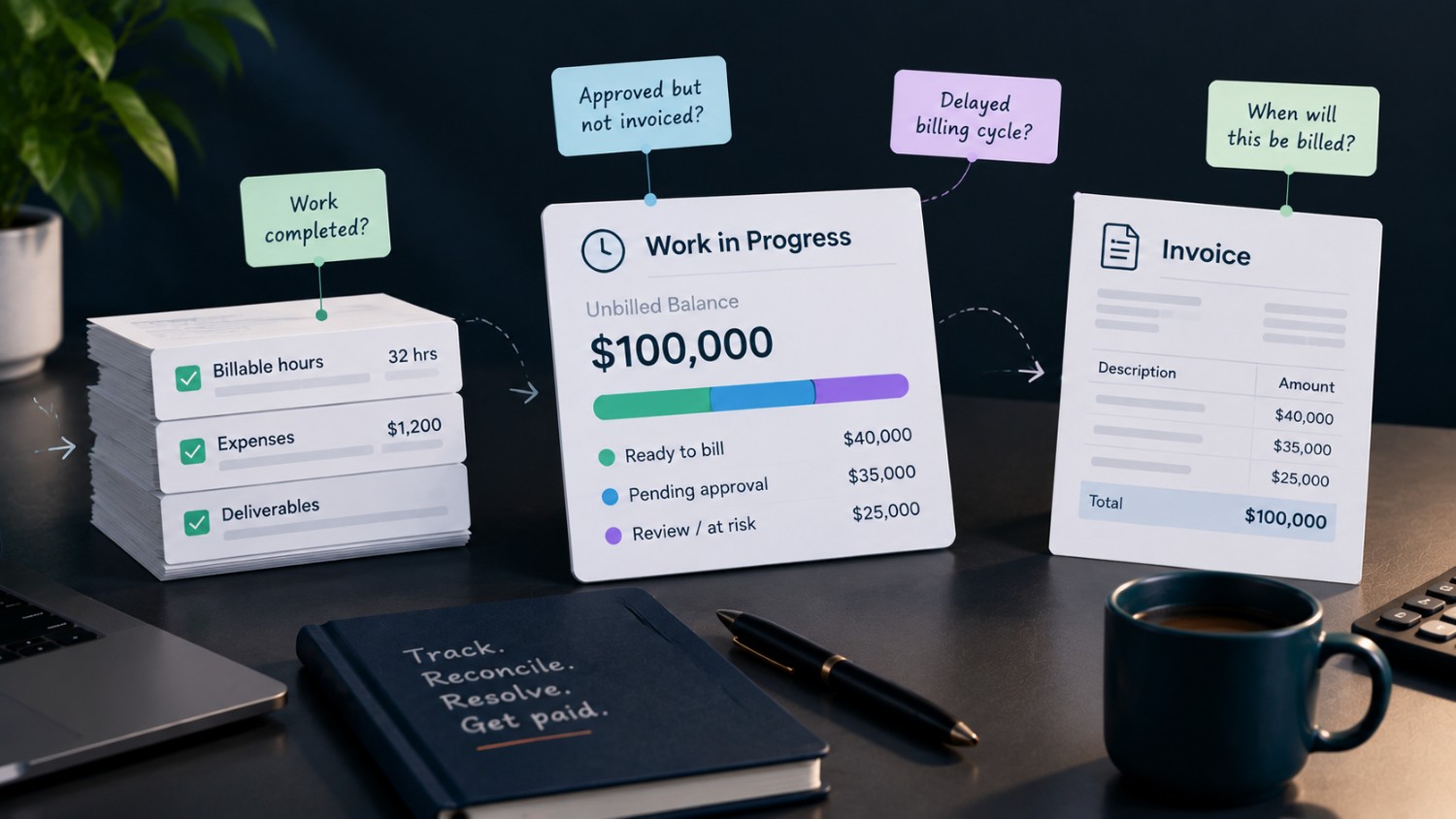
A $100,000 unbilled balance could represent work scheduled for next month’s invoice, completed services waiting for approval, or additional hours the client never agreed to pay for. The total alone does not show how much can be billed or when the cash is likely to arrive.
Work in progress accounting helps professional services organizations understand what makes up that balance. Comparing unbilled work with contract terms and delivery records shows what is on schedule, what is delayed, and which amounts may need to be reduced.
The review becomes more complex when an organization combines time-and-materials projects, fixed fees, and client retainers. Each can produce unbilled work, but how you calculate its value—and when you can invoice it—depends on the agreement.
Key Takeaways
- Separate operational WIP from recognized revenue; an unbilled work report does not automatically establish an accounting asset.
- Calculate unbilled value using the agreement’s rates, fees, and billing conditions rather than applying hourly rates to every engagement.
- Compare WIP age with the contractual billing schedule to distinguish expected timing from overdue action.
- Reconcile additions, invoices, and adjustments so a falling balance does not hide write-downs.
- Assign each delayed item an owner, a specific next action, and an expected resolution date.
What Is Work in Progress Accounting in Professional Services?
In professional services, work in progress accounting (WIP accounting) tracks work performed but not yet billed and reconciles it with the organization’s accounting records. Operational WIP can include unbilled time, reimbursable expenses, and services delivered before a contractual billing event.
For example, a consultancy may have approved hours awaiting its monthly invoice run. An agency may have completed part of a fixed-fee engagement but not yet reached the next billing milestone. Both have work to monitor, although the value and accounting treatment depend on their agreements.
WIP reports may also include entries awaiting review, such as time recorded against disputed scope. Identify those amounts separately because some may be reduced or excluded from the final invoice.
How Does WIP Differ From Unbilled Revenue and Accounts Receivable?
Operational WIP tracks work that has not yet been billed. Some of that work may already count as recognized revenue, making it unbilled revenue. If the right to payment is unconditional—meaning only time must pass before payment is due—the amount is a receivable, even if an invoice has not been issued. Because the same amount can appear in more than one category, adding the balances together could double-count its value.
Under ASC 606 guidance on contract assets and receivables, the distinction depends on whether any conditions remain before the organization has an unconditional right to payment, not simply whether it has issued an invoice.
For management reporting, make clear what each balance includes and explain any differences between the operational WIP report and finance’s accounting records. That keeps delivery and finance from using “WIP” to mean different amounts without realizing it.
How to Calculate WIP for Professional Services
Start with the work that has been performed but not yet billed, then apply the engagement agreement’s pricing and billing terms. For time-and-materials work, that usually means hours multiplied by the applicable rates, plus reimbursable expenses. Fixed fees and retainers require a closer look at what the client has agreed to pay and when those charges can be invoiced.
Approved Unbilled Time and Expenses
For a time-and-materials engagement, calculate the value of each approved, unbilled time entry using its billing rate. Add approved expenses that can be charged to the client, then deduct any discounts or reductions required by the agreement, including amounts above a contractual cap.
Approved unbilled value = total approved unbilled time at applicable rates + approved unbilled expenses − applicable reductions
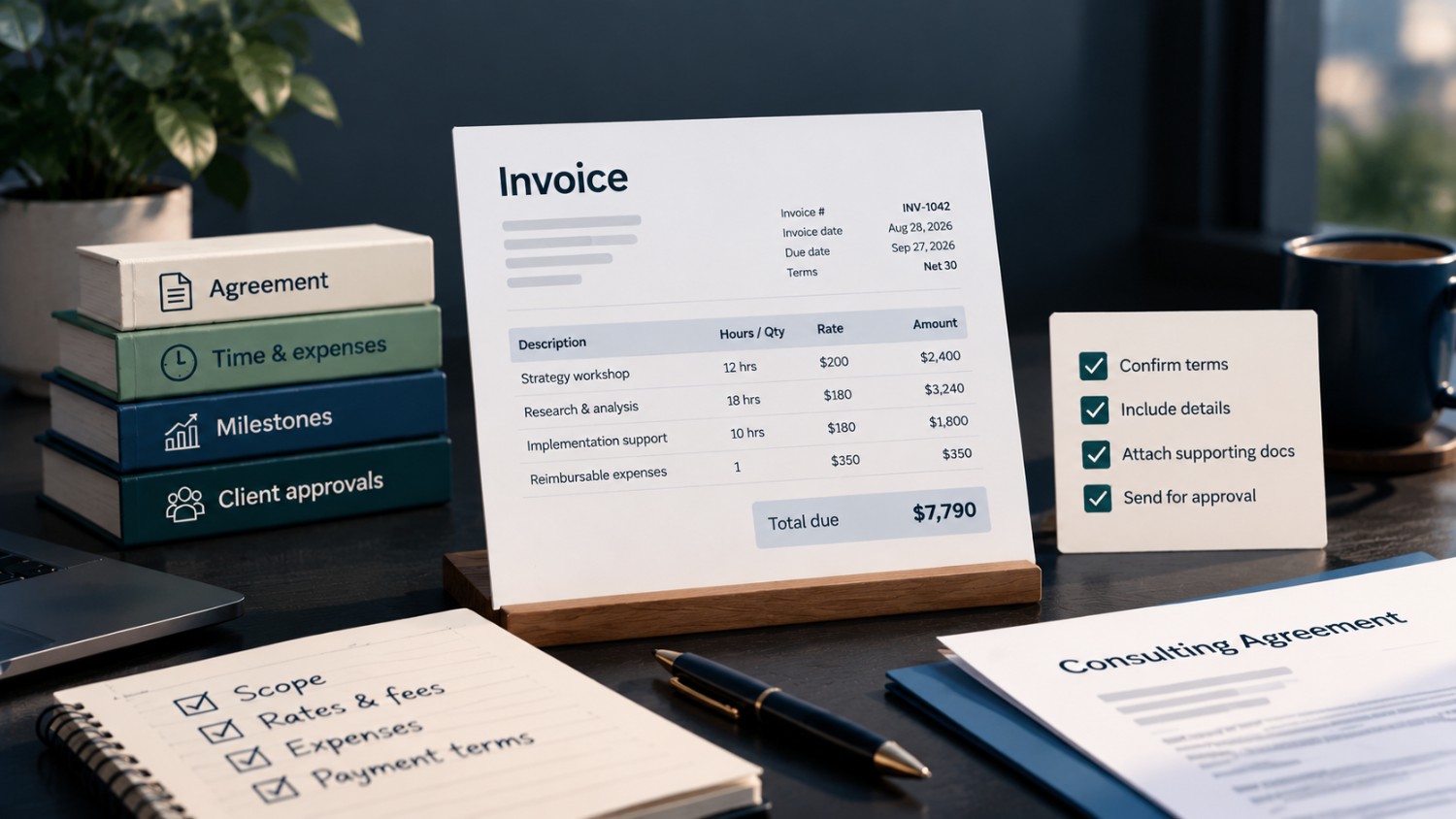
Consider a consulting engagement with the following activity. The expenses are reimbursable at cost, and no discounts or caps apply.
The engagement has $9,500 in approved, unbilled time and expenses. Whether the full amount can be invoiced now depends on the remaining billing conditions. If the contract also requires client approval, that approval should appear as an outstanding action in the report.
Time awaiting internal approval should remain visible in a separate category. Otherwise, the team could overlook work simply because it has not yet qualified for the approved total.
Fixed Fees, Milestones, and Retainers
On a fixed-fee project, valuing every hour at a billing rate can make the unbilled balance look more valuable than it is. If a $50,000 engagement takes more hours than planned, the extra effort increases delivery cost and reduces margin. It does not increase the agreed fee unless the contract or an approved change allows an additional charge. A WIP calculation that includes those hours as extra billable value could therefore overstate future invoices while obscuring a cost overrun.
Revenue recognition depends on fulfilling the obligations in the client agreement, not simply using up the project budget. Under IFRS 15, when revenue qualifies for recognition over time, the amount recognized must reflect an appropriate measure of progress toward fulfilling those obligations. A project could consume half its budget because work took longer or required more expensive resources than planned. That does not necessarily mean half the promised services have been delivered, or that half the fee can be recognized as revenue.
Once revenue has been determined, compare it with the amount billed. If an engagement has $30,000 in recognized revenue and $20,000 in billings, the $10,000 difference helps finance identify and reconcile revenue that has not yet been invoiced. But note that the calculation does not determine how much revenue should be recognized.
A fixed-fee agreement may also use milestone billing. In that case, review delivery progress alongside the next billing milestone and any acceptance requirements. An unbilled balance may reflect work progressing toward an agreed milestone rather than a billing delay, even when the next invoice is several weeks away.
For retainers, the WIP balance should reflect work that remains to be billed, such as services billed after delivery or approved overages. Work already covered by an advance payment should not be counted again as unbilled value. An unused prepaid balance represents services still owed to the client. If the team exceeds the included hours, check whether the agreement allows an additional charge before adding that effort to the billable balance.
What Are the Journal Entries for WIP Accounting?
Recording WIP starts with confirming how much revenue can be recognized and whether any contractual conditions remain before the organization has an unconditional right to payment. The operational WIP report provides supporting detail, but its total does not automatically qualify as revenue.
Suppose $10,000 qualifies for revenue recognition, but the right to payment still depends on meeting another contractual condition. Finance records the $10,000 as revenue and a contract asset. Once that condition is met and the payment right becomes unconditional, Finance transfers the balance from the contract asset to accounts receivable.
The simplified entries below exclude taxes and other adjustments.
These entries illustrate the distinction between contract assets and receivables under ASC 606. If the payment right is already unconditional when revenue is recognized, finance may record a receivable directly. Invoicing that amount later does not mean recognizing the revenue a second time.
The WIP report should provide the records supporting those entries, including work dates, approved amounts, billing history, and outstanding contract conditions. That gives Finance a clear explanation of the balance without having to reconstruct the project from emails and separate spreadsheets.
Common Delays in WIP Billing
Billing is often delayed because someone still needs to confirm what can be charged, correct a record, or approve the work. Even when revenue and costs have been recorded correctly, missing the scheduled invoice run can push the expected payment date further out.
A billing delay does not automatically reduce project margin. If revenue and costs are already recorded correctly, the immediate effect may simply be that payment arrives later. But if resolving the delay requires a fee reduction, or you cannot recover some of the amount, profitability may also suffer.
Missing time creates a different problem: the WIP balance may look lower than it should. A review of recorded entries alone can miss billable work that was never logged.
What Should a WIP Aging Review Include?
A WIP aging review should show how long work has remained unbilled, when the agreement allows it to be billed, and what is preventing the next step. A weekly review can help teams managing frequent time entries and invoices, while the timing and depth should reflect the billing cycle and amounts involved.
Compare age with the agreed billing date.
Include the work date or service period, the agreed billing date or milestone, and the expected invoice date. Apply the same aging method across reports so changes are easy to interpret.
For example, work unbilled for 45 days may still be on schedule if the contract calls for billing at a milestone expected on day 60. A 15-day-old balance that missed a weekly invoice run may require more immediate attention.
Both balances affect when cash is expected, but they call for different responses. The first may simply reflect the agreed payment schedule. The second requires someone to resolve the delay.
Age buckets help prioritize the review, but contract terms explain whether an item is overdue for billing. If long periods of unbilled work are common even when projects run smoothly, consider whether future agreements should include more frequent billing.
Separate amounts by billing status.
Show which amounts are ready for the next invoice, which are waiting for a scheduled billing event, and which need further review. For items requiring attention, describe the specific issue instead of marking them only as “on hold.”
Each item should identify:
- The client and project.
- The amount and how it was calculated.
- The work date or service period.
- The agreed billing date or condition.
- The expected invoice date.
- The person responsible and the next action.
If the report also includes recognized revenue, label that amount separately and explain any differences from the operational WIP value.
“Client approval outstanding; account lead to follow up by Friday” provides a clear next step. “Awaiting review” leaves the team guessing about both responsibility and timing.
Explain changes in the balance.
Show how the opening balance changed as new work was recorded, invoices were issued, and amounts were adjusted or removed. A falling WIP balance may reflect successful billing, but it can also reflect work the organization no longer expects to charge for.
Record the reasons for those reductions. Recurring fee concessions for one client may point to a scope or pricing issue. Frequent project-coding corrections across several teams suggest a different process problem.
Removing an amount from the operational report does not automatically mean recording a loss in the accounts. Finance should first confirm whether any related revenue or asset was recognized and why the expected amount has changed.
Assign resolution and escalation dates.
Decide when to escalate an unresolved item based on its value, how far past the agreed billing date it is, and whether another invoice run is approaching.
Assign the action to the person who can resolve it. A project manager may need to provide evidence of completion, an account lead may need to agree a fee with the client, or finance may need to correct the invoice.
Keep a history of unresolved items, including why expected invoice dates changed. Moving a date forward every week without explaining the delay makes the cash forecast look more certain than the underlying balance supports.
Improving WIP Visibility with Connected Project Data
When project activity, contract terms, and billing records are connected, you can investigate an unbilled balance without rebuilding the same spreadsheet each month. You can trace each amount back to the work performed and see what has already been invoiced.
Accelo’s project financials connect time, expenses, budgets, retainers, and invoicing so you can review them together. Project WIP reports include project budgets, usage forecasts, and invoice amounts, helping you compare work underway with billing progress. Book a Demo to see how Accelo connects project activity and financial reporting to support your next WIP review.
Read Next
- Project Accounting: A Practical Guide for Professional Services
- Milestone Billing: How It Works, Examples, and Best Practices
Frequently Asked Questions
Is WIP the same as unbilled revenue?
No. Operational WIP tracks work that has not yet been billed and may include amounts still under review. Unbilled revenue has already been recognized in the accounts but has not yet been invoiced. Some amounts may appear in both categories, so the balances should not be added together.
What is the formula for WIP in professional services?
For approved, unbilled time-and-materials work, multiply the hours by their applicable billing rates, add reimbursable expenses, and apply any contractual reductions. Fixed-fee work requires a calculation that reflects the agreement and the purpose of the report. Applying a standard hourly rate to every hour worked can overstate what the client owes.
Does higher WIP mean higher profit?
No. A larger WIP balance may reflect more work awaiting the next invoice, delayed approvals, or amounts that will be reduced before billing. Profit depends on recognized revenue and costs. The WIP review helps establish what remains unbilled and how much the organization expects to invoice.
How old is too old for WIP?
There is no universal age limit. Compare the age of the work with the agreed billing schedule and any outstanding conditions. An amount that missed its scheduled invoice needs a different response from work awaiting a future milestone, even if the milestone work has been unbilled for longer.
What is a WIP write-down?
A WIP write-down reduces the value assigned to unbilled work, often because of a fee concession or a decision not to charge for some of the effort. Its accounting effect depends on what was previously recorded and why the amount changed. Writing down unbilled work is different from writing off a receivable that cannot be collected.




.svg)


.svg)