Overview
- Revenue leakage is the gap between what a professional services firm earns through delivery and what it actually invoices and collects; money that exits the business before it reaches a bill.
- The most common sources are untracked hours, absorbed scope changes, relationship write-downs, and rework from misaligned project assumptions.
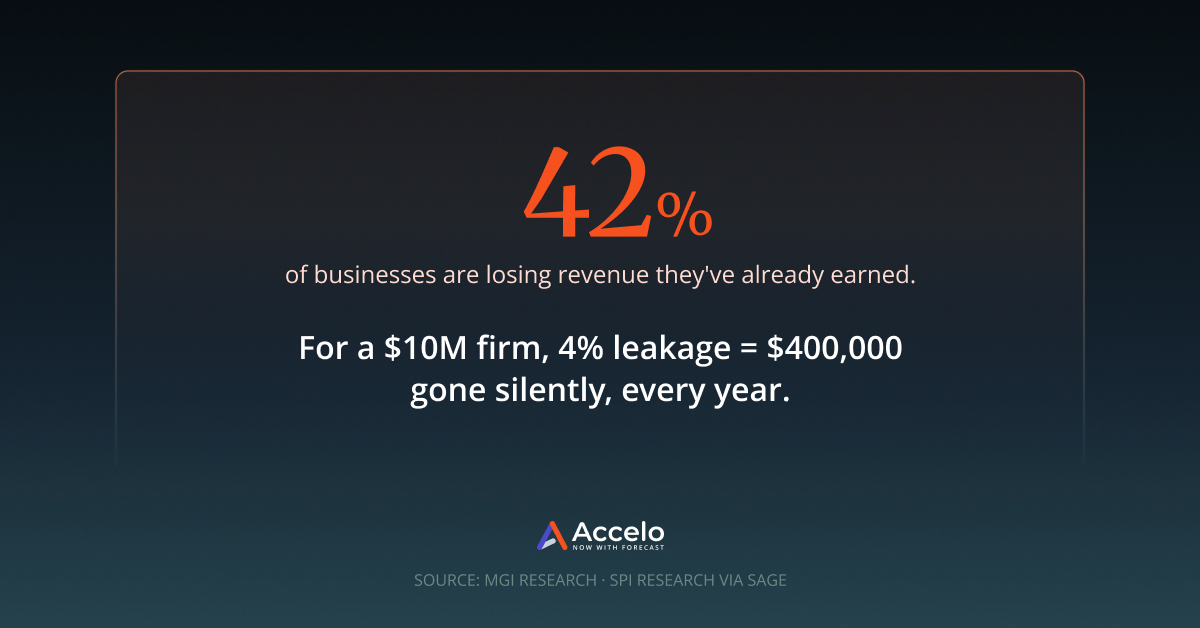
- According to MGI Research, 42% of professional services firms experience revenue leakage, with the average firm losing 4.3% of annual revenue - equivalent to $430,000 on a $10M firm.
What is Revenue Leakage?
Revenue leakage is the gap between the revenue a business earns through its work and the revenue it ultimately invoices and collects. It occurs when money that should have been billed or recovered is lost because of operational inefficiencies, process failures, or overlooked gaps. This "lost" revenue can occur in any stage of the business cycle, from invoicing errors to poor contract management.
Revenue leakage is not a single event; it is a pattern of small, recurring losses that accumulate across projects, clients, and billing cycles without appearing as a discrete line-item loss on any report. Unlike a write-off, which is a deliberate accounting decision, revenue leakage is largely invisible. It happens in the gaps between time worked and time logged, between scope agreed and scope delivered, between work completed and invoice sent. By the time most firms detect it, the billing window has closed and the revenue cannot be recovered.
What Are Common Causes of Revenue Leakage?
Revenue leakage can occur for a variety of reasons, some of which may be difficult to spot in day-to-day operations. Here are some of the most common causes:
1. Inaccurate billing
Inaccurate billing is one of the most common sources of revenue leakage. Mistakes can occur during the invoicing process, such as billing for the wrong amount, missing items or services that should have been charged, or using incorrect pricing structures. These errors can happen manually or be embedded in automated billing systems that aren’t properly updated.
For example, if a company offers services on a subscription or fixed-fee basis, they might undercharge customers by not including additional usage fees or discounts applied incorrectly. This can result in significant revenue loss over time.
2. Absorbed scope changes
Scope creep that goes unaddressed is one of the largest sources of revenue leakage. When additional requests, revisions, or deliverables are absorbed into a project without a change order, often to maintain client relationships or avoid difficult conversations, the firm delivers more than it contracted to deliver and bills for what was originally agreed. The hours are real. The invoice isn't.
3. Poor contract management
Contracts form the backbone of many business relationships, particularly in agencies, consultancies, and other professional services organizations. However, poor management of these contracts can lead to revenue leakage. This can include failure to enforce contract terms, such as price increases, renewal rates, or penalties for late payments.
Sometimes businesses fail to monitor contracts effectively, allowing outdated terms to persist, resulting in lost revenue opportunities. If an organization continues providing services without realizing that a contract renewal includes a price increase, they’re essentially leaving money on the table.
4. Poor scoping and unbilled rework
When project scope, client expectations, or technical requirements aren't clearly defined upfront, rework is almost inevitable. Those additional hours represent real costs, but they often never make it onto an invoice. Without structured change management and clear approval processes, organizations absorb the cost of extra work instead of billing for it, creating one of the most common—and preventable—forms of revenue leakage.
5. Excessive discounting
Discounting can help win new business or retain existing clients, but excessive or unauthorized discounts reduce profitability before work even begins. Revenue leakage occurs when organizations discount without understanding the true cost to deliver a project, fail to enforce pricing policies, or don't accurately track discounts through invoicing. Even small pricing concessions can significantly erode margins over time.
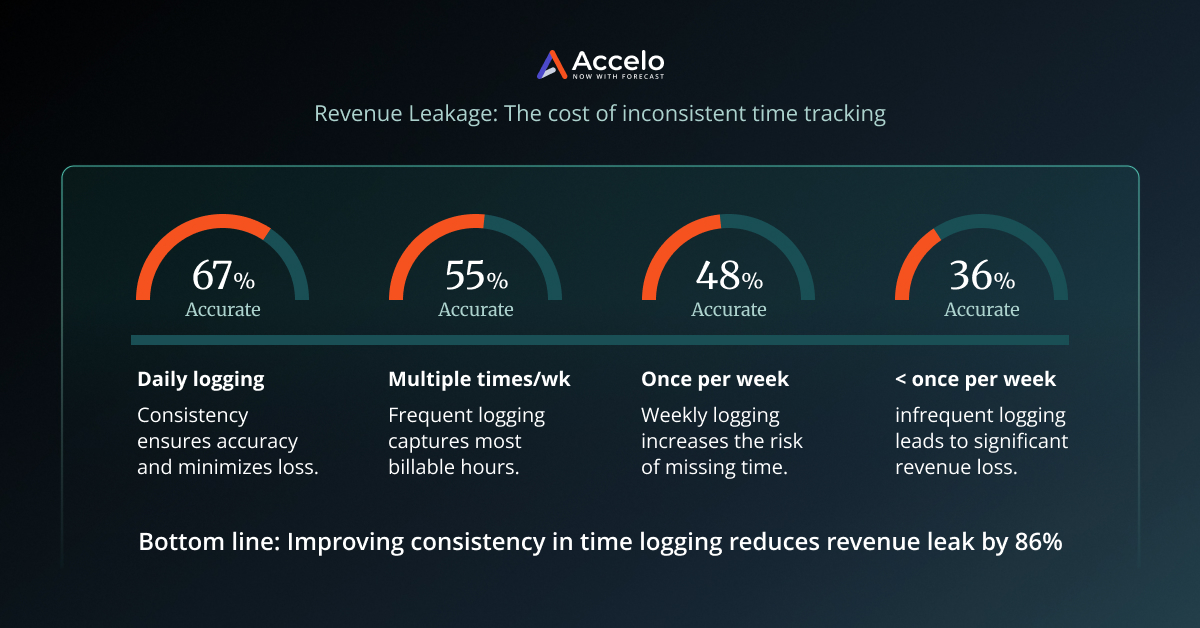
6. Inconsistent time tracking
Time worked but never logged is the most common and most costly source of leakage. It happens when consultants reconstruct their hours from memory at the end of the week, when short client calls go unrecorded, or when small tasks are absorbed informally without a time entry. At one untracked hour per person per week, a 40-person billable team at a $150 average bill rate loses $300,000 annually in revenue that was earned but never invoiced.
7. Service delivery failures and write-downs
Revenue leaks when organizations absorb the cost of delivery mistakes instead of billing for them. This can happen through refunds, service credits, or clients leaving after poor delivery. It also occurs when project managers or consultants write down billable hours before invoicing because they believe the extra time resulted from the organization's own mistakes. While write-downs are sometimes the right decision, inconsistent or untracked write-downs quietly erode margins and can become a significant source of revenue leakage over time.
8. Manual errors and inefficiencies
Human error is inevitable, but when it comes to revenue management, these mistakes can be costly. Manual data entry errors, delayed invoicing, and discrepancies in record-keeping can all contribute to revenue leakage. The more complex an organization's delivery and billing processes become, the greater the likelihood that errors will slip through.
9. Unpaid invoices
Unpaid invoices or delayed payments are another significant source of revenue leakage. Even with a sound invoicing system in place, some clients may fail to pay on time or at all. If businesses do not have a robust collections process, they may write off unpaid invoices as bad debt, which contributes directly to revenue loss.
How Much Revenue Do Professional Services Firms Lose to Revenue Leakage?
Research suggests revenue leakage is far more common than most organizations realize. According to MGI Research, 42% of businesses experience some form of revenue leakage, and professional services organizations lose an average of 4.3% of annual revenue to work that is never billed or collected.
For a professional services organization generating $10 million in annual revenue, that's approximately $430,000 disappearing each year—not because demand is lacking, but because earned revenue slips through operational gaps. For organizations that rely heavily on retainers, the risk is even greater. SparkToro reports that 85% of digital agencies primarily operate on a retainer model, making accurate time tracking and scope management essential. Without visibility into time worked against each retainer, organizations often exceed the agreed scope without recognizing it until profitability has already been lost.
Because revenue leakage is incremental rather than catastrophic, it often goes unnoticed. Organizations typically discover the problem only during project reviews or financial reconciliation, long after the opportunity to recover that revenue has passed.
How Can Professional Services Firms Prevent Revenue Leakage?
Preventing revenue leakage starts long before an invoice is sent. The organizations that protect their margins don't rely on finance teams to catch missed revenue after the fact; they build operational controls that ensure billable work is captured, approved, and invoiced as it happens.
The following practices help reduce revenue leakage across the entire quote-to-cash lifecycle.
Capture time as work happens.
Late or incomplete timesheets are one of the largest sources of revenue leakage. The longer people wait to record their time, the more billable work is forgotten or underestimated.
Automated time tracking and time entry that is connected directly to projects, tasks, emails, and meetings improve accuracy while reducing the administrative burden on consultants. More complete time records lead to more accurate invoices and better visibility into project profitability. Modern AI-assisted time tracking goes a step further by suggesting time entries based on actual work completed. This reduces manual effort while helping organizations capture more billable time and close revenue gaps before they impact the bottom line. See how Accelo's AI-assisted time tracking improves accuracy, reduces administrative effort, and protects revenue.
Monitor project budgets in real time.
Most projects don't become unprofitable overnight. Scope creep, additional client requests, and delivery delays accumulate gradually until the budget has already been exceeded. Giving project managers real-time visibility into budget consumption, burn rate, and remaining hours allows them to identify issues early, discuss scope changes with clients, and take corrective action before revenue is lost. See how Accelo helps teams monitor project budgets in real time and identify margin risk before it impacts profitability.
Formalize change management.
Additional work shouldn't automatically become free work. Organizations with structured change control processes document scope changes, obtain client approval, and connect approved changes directly to project plans and invoices. This ensures extra work becomes additional revenue instead of absorbed cost.
Connect delivery and billing.
Revenue leakage often occurs during handoffs between sales, project delivery, finance, and billing. Every manual spreadsheet, disconnected system, or duplicate data entry creates another opportunity for billable work to be missed. Connecting CRM, project management, resource management, time tracking, invoicing, and financial reporting within a single platform creates a continuous quote-to-cash workflow where every billable hour has a clear path to an invoice.
"Now that we have time tracking in a system that connects with everything we are working on, our billable utilization has gone from an average of 40% to closer to 75%. It’s a huge change that has made Grafikr a lot more profitable." - Kiranan Luxmy, CEO, Graffikr (Denmark)
Use data to identify leakage early.
Revenue leakage is difficult to eliminate if you only discover it after a project has closed. Organizations that monitor utilization rate, realization, write-downs, budget variance, WIP, invoice aging, and profitability trends can identify recurring patterns before they become systemic issues. Revenue leakage often appears as lower realization rates because billable work is delivered but never converted into revenue. Monitoring both metrics gives organizations a clearer picture of financial performance. The goal isn't simply to recover lost revenue; it's to prevent it from leaking in the first place.
How Accelo Helps Prevent Revenue Leakage
Accelo helps professional services organizations reduce revenue leakage by connecting the entire client lifecycle—from the initial quote through project delivery, time tracking, invoicing, and payment collection—in a single platform.
Because project delivery, time, budgets, resources, client communications, and financials all live in the same platform, organizations gain real-time visibility into project health and profitability before revenue is lost. Automated time tracking captures more billable work, live budget monitoring surfaces scope creep early, and connected quote-to-cash workflows ensure approved work flows directly into invoices with fewer manual handoffs. Rather than trying to recover lost revenue after projects are complete, Accelo helps organizations prevent revenue leakage as work is delivered. See Accelo in action.
Turning Revenue Leakage Into Revenue Growth
Revenue leakage is rarely caused by one major mistake. It's the cumulative effect of dozens of small operational gaps across the quote-to-cash process. Missed time entries, unmanaged scope changes, disconnected systems, delayed invoices, and inconsistent write-downs can each seem insignificant on their own, but together they can quietly erode profitability.
The organizations that minimize revenue leakage don't simply invoice faster; they create connected workflows that capture work accurately, provide real-time visibility into delivery and financial performance, and ensure earned revenue doesn't go unbilled. By identifying leakage before it reaches the invoice, professional services organizations can improve margins, increase profitability, and build a more predictable business.
Continue Learning About Professional Services Profitability
If you're looking to improve profitability beyond preventing revenue leakage, these resources explore the operational metrics, systems, and strategies that help professional services organizations capture more revenue and deliver more profitable projects.
- Why Successful Projects Miss Profit Targets: A look at four practical scenarios that create revenue gaps in every professional services firm.
- The Utilization Rate Benchmarks Every Professional Services Leader Should Know: Learn how utilization rate measures your team's billable capacity, why it's one of the strongest predictors of profitability, and what benchmarks professional services organizations should target.
- Scaling Professional Services Profitably: The Operational Curve Behind Predictable Growth: Discover how successful organizations build operational maturity to support sustainable growth without sacrificing margins.
- 2026 Professional Services Performance Benchmarks: Compare your organization's utilization, realization, project delivery, and financial performance against industry benchmarks.
Revenue Leakage FAQs
What is revenue leakage in professional services?
Revenue leakage is the difference between the value a professional services organization delivers and the revenue it ultimately invoices and collects. Common causes include untracked billable hours, scope creep, write-downs, delayed invoicing, billing errors, and disconnected business systems that allow earned revenue to go unbilled.
How common is revenue leakage?
Revenue leakage is more common than many organizations realize. According to MGI Research, 42% of businesses experience some form of revenue leakage, and professional services organizations lose an average of 4.3% of annual revenue. For a business generating $10 million annually, that's approximately $430,000 in earned revenue that never gets collected.
What is the biggest cause of revenue leakage?
For most professional services organizations, the biggest source of revenue leakage is inaccurate or incomplete time tracking. When consultants reconstruct timesheets from memory instead of recording work as it happens, billable hours are often forgotten, underestimated, or never invoiced.
What is the difference between revenue leakage and write-offs?
Revenue leakage occurs before an invoice is issued and includes revenue that is never billed because of missed time, scope changes, write-downs, or process failures. A write-off occurs after an invoice has been created and represents revenue the organization decides it cannot collect. In short, revenue leakage is largely invisible, while write-offs are recorded accounting events.
How can professional services firms reduce revenue leakage?
Reducing revenue leakage requires operational visibility across the entire quote-to-cash process. Organizations that connect time tracking, project management, budgeting, billing, and financial reporting can identify missed revenue earlier, manage scope proactively, and ensure more billable work is captured and invoiced accurately.
Can PSA software help prevent revenue leakage?
Yes. Professional Services Automation (PSA) software helps reduce revenue leakage by connecting sales, project delivery, time tracking, resource management, invoicing, and financial reporting in a single platform. This gives organizations real-time visibility into project health, automates manual processes, and helps ensure earned revenue is captured before it slips through the cracks. See how Accelo helps professional services organizations reduce revenue leakage. Book a personalized demo.

.svg)