EBITDA, which stands for Earnings Before Interest, Taxes, Depreciation, and Amortization, measures a company's operating profitability before financing, tax, and non-cash accounting expenses. It's commonly used to evaluate financial performance, compare companies, and assess long-term profitability.
Overview
- EBITDA (Earnings Before Interest, Taxes, Depreciation, and Amortization) measures a company's operating profitability before financing, taxes, and certain accounting expenses.
- Professional services organizations typically target EBITDA margins between 10% and 20%, although performance varies by firm size, maturity, and business model.
- EBITDA is influenced by both project profitability and operating overhead. Strong project margins don't always translate into healthy EBITDA.
- Common EBITDA challenges include revenue leakage, low utilization, scope creep, rising overhead, and inefficient resource management.
- Improving EBITDA requires increasing revenue while controlling delivery costs and operational expenses.
- Professional Services Automation (PSA) software helps improve EBITDA by providing visibility into project financials, utilization, revenue leakage, and profitability before issues affect the bottom line.
What Is EBITDA?
EBITDA is one of the most widely used financial metrics for evaluating a company's operating performance because it focuses on the business's profitability rather than its financing or tax structure. By excluding interest, taxes, depreciation, and amortization, EBITDA makes it easier to compare organizations with different capital structures, tax strategies, or accounting methods.
For professional services organizations, EBITDA provides a broader measure of financial health than project-level metrics alone. While project margins indicate whether individual client engagements are profitable, EBITDA reflects the overall efficiency of the business after considering operating expenses such as sales and marketing, administrative costs, software, facilities, and other overhead.
Because of this, executives, investors, lenders, and private equity firms frequently use EBITDA to evaluate operational performance, benchmark organizations against competitors, and estimate company value during acquisitions.
How is EBITDA Calculated?
EBITDA can be calculated using either net income or operating income, depending on the available financial statements. Both methods arrive at the same result by removing financing costs, taxes, and non-cash accounting expenses to focus on operating profitability.
Method 1: Starting with Net Income
EBITDA = Net Income + Interest + Taxes + Depreciation + Amortization
Method 2: Starting with Operating Income
EBITDA = Operating Income + Depreciation + Amortization
Example Calculation
Example only. EBITDA and EBITDA margin will vary based on an organization's revenue, operating costs, and business model.
While EBITDA provides a standardized way to evaluate operating performance, it should be considered alongside other financial metrics, including net profit, cash flow, and project profitability, to gain a complete picture of an organization's financial health. EBITDA margin measures EBITDA as a percentage of revenue and is commonly used to compare profitability across organizations of different sizes.
For professional services organizations, EBITDA margin is one of the most closely watched financial benchmarks. It is commonly used by executives to evaluate operating performance, by boards to measure management effectiveness, and by lenders, acquirers, and private equity firms during due diligence and valuation.
What is a Good EBITDA Margin for a Professional Services Organization?
EBITDA benchmarks vary by business model, and not every professional services organization should expect the same EBITDA margin. Differences in pricing strategy, revenue mix, and operating costs naturally influence profitability. The following ranges provide useful benchmarks:
What are EBITDA margin trends in professional services?
Professional services organizations have faced increasing pressure on profitability in recent years, with EBITDA declining. According to SPI Research, the average EBITDA margin fell from 15.4% in 2023 to 9.8% in 2024, recovering only slightly to 9.9% in 2025. That's well below the five-year average of 13.8%, suggesting today's margin compression is more than a temporary slowdown; it's becoming a structural challenge for many organizations.
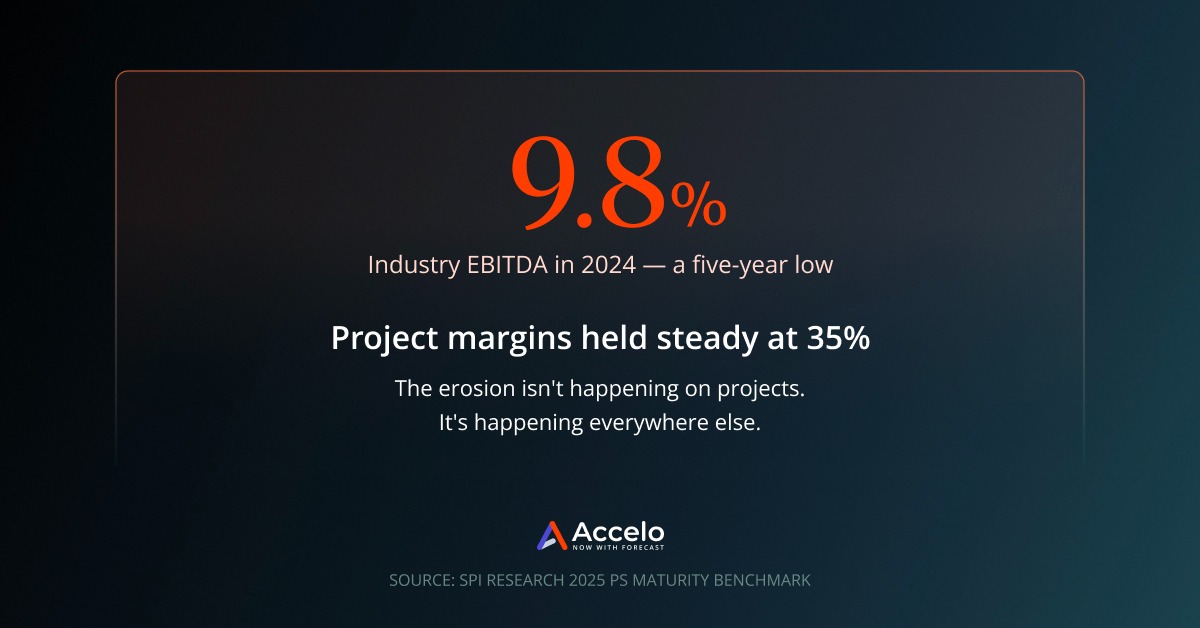
Several factors are contributing to this trend, including rising labor costs, increased software and operating expenses, lower utilization rates, revenue leakage, and growing pressure to deliver more value without a proportional increase in fees. For many organizations, improving EBITDA now requires greater operational discipline rather than simply generating more revenue.
Why is EBITDA Lower Than Project Margin?
Project margin and EBITDA both measure profitability, but they answer very different questions.
Project margin measures how profitable an individual client engagement is after accounting for the direct costs of delivering the work.
EBITDA measures how profitable the entire organization is after covering both delivery costs and ongoing operating expenses.
That means an organization can consistently deliver profitable projects while still producing disappointing EBITDA if overhead grows faster than revenue.
For example, project margin typically includes direct delivery costs such as employee compensation, contractors, and project-specific expenses. EBITDA goes further by accounting for the costs of running the business, including sales and marketing, finance, HR, executive leadership, office expenses, software subscriptions, insurance, and other administrative overhead.
As organizations grow, these operating costs often increase faster than project revenue. Unless utilization, pricing, and operational efficiency improve at the same pace, EBITDA margins begin to shrink, even when individual projects remain profitable.
This is why professional services leaders monitor both metrics. Project margin helps optimize delivery performance, while EBITDA reveals whether the business as a whole is generating sustainable operating profit.
Key differences between EBITDA vs project margin
The difference between project margin and EBITDA is largely explained by operating overhead. While exact costs vary by organization, the categories below account for most of the gap between project profitability and company profitability.
These operating expenses are necessary to run and grow a professional services business, but they aren't assigned to individual projects. When overhead remains aligned with revenue growth, organizations can maintain healthy EBITDA margins. When overhead grows faster than revenue, EBITDA declines, even if project margins remain strong.
Why is my EBITDA Declining?
Even organizations that consistently deliver successful projects can experience a decline in EBITDA. In most cases, the problem isn't a single issue; it's the combined impact of lower utilization, shrinking margins, rising overhead, and operational inefficiencies. The following are some of the most common causes.
Low utilization reduces revenue without lowering costs.
Research has found that a 1% improvement in utilization can increase operating profit up to 20%. When billable employees spend less time on client work, payroll and operating expenses remain largely unchanged while revenue declines, creating an outsized impact on EBITDA. Even a small reduction in utilization can have a significant impact on EBITDA because fixed costs are spread across less revenue.
Related: Calculating Resource Utilization and Billable Utilization–and How to Improve Both
Revenue leakage erodes profitability.
According to MGI Research, 42% of companies have some form of revenue leakage, amounting to 1-5% of annual revenue. Revenue leakage occurs when organizations fail to capture or invoice work they've already delivered. Untracked time, scope creep, delayed billing, write-downs, and inconsistent contract management all reduce revenue without lowering costs, directly impacting EBITDA.
Related: Understanding Revenue Leakage and How to Prevent It
Operating costs grow faster than revenue.
As organizations grow, they often add management layers, software, administrative staff, and other overhead. According to SPI Research, the average professional services organization now spends approximately 24% of revenue on sales, general and administrative expenses, and other operating overhead. When these investments increase faster than revenue, operating expenses consume a larger share of income, reducing EBITDA even when project delivery remains profitable.
Related: Which Operational Inefficiency is Sabotaging Your Profitability?
Poor resource planning creates delivery inefficiencies.
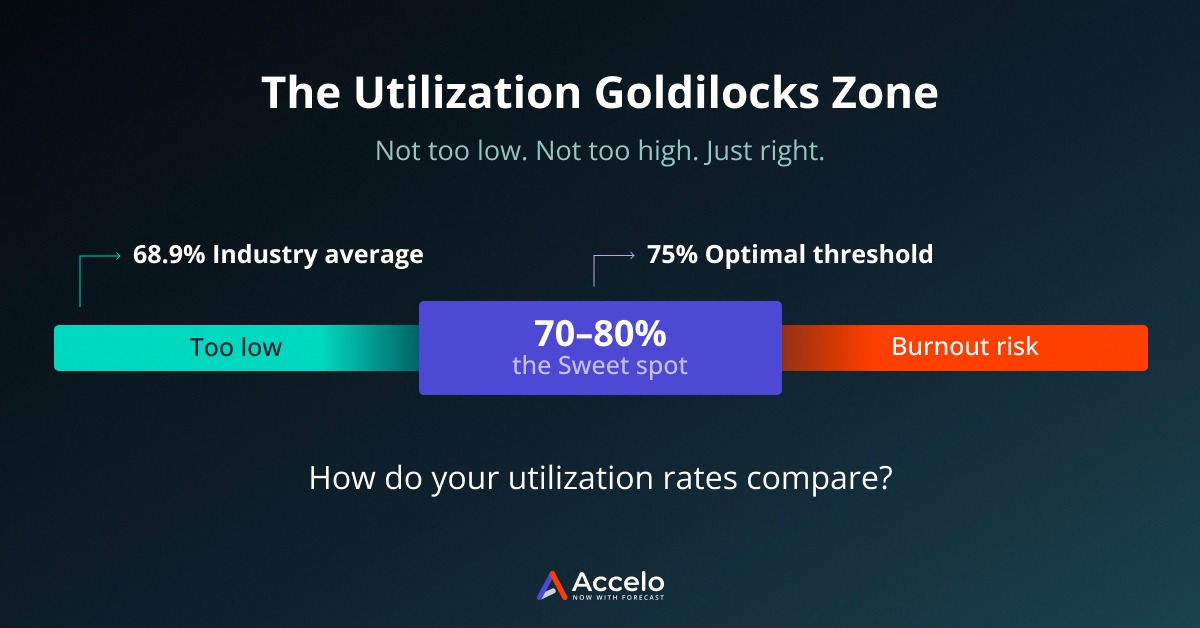
According to SPI Research, average utilization declined to 68.9% in 2025, well below the 75% utilization rate many professional services organizations target for healthy profitability. Lower utilization means fewer billable hours are available to absorb fixed operating costs, putting downward pressure on EBITDA.
Poor resource planning often leaves some employees overloaded while others sit on the bench. The result is missed deadlines, inconsistent utilization, unnecessary contractor spend, and reduced operational efficiency. Improving visibility into team capacity and future demand helps organizations balance workloads, increase billable utilization, and protect profitability.
Related: What Is Resource Management?
Pricing and scope management fall behind costs.
Labor costs continue to rise, but many organizations struggle to increase pricing at the same pace. Combined with unmanaged scope creep and fixed-fee engagements, shrinking project margins eventually translate into lower EBITDA.
“Accelo helped us evaluate which contracts are profitable and which ones need more account management. Before rate increases, we pull a report of activity and time against contracts, so we are much better informed.” - Sam Arseneau, CEO, SupportMyMac (Canada)
Delayed visibility prevents early course corrections.
EBITDA rarely declines because of one major event. More often, it reflects the cumulative effect of small operational inefficiencies that go unnoticed over time. Unfortunately, many organizations don't discover margin erosion until month-end financial reporting, by which point it's too late to change the outcome. By the time declining utilization, budget overruns, or unbilled work appear in financial reports, the opportunity to recover lost profitability has often passed. In contrast, organizations that continuously monitor utilization, project financials, revenue leakage, and operating costs are better positioned to identify risks early and protect long-term profitability.
Why Does EBITDA Matter Beyond Profitability?
EBITDA isn't just a measure of current profitability; it also influences how investors, lenders, and potential buyers evaluate a business. Because EBITDA focuses on operating performance, it's commonly used to compare organizations, assess financial health, and estimate company value.
Professional services organizations with consistently strong EBITDA margins are often viewed as lower-risk investments because they demonstrate operational discipline, predictable profitability, and the ability to generate sustainable cash flow. Conversely, declining EBITDA may indicate underlying issues with utilization, pricing, overhead management, or delivery efficiency that can reduce both profitability and valuation.
While EBITDA is only one factor in determining company value, improving operational performance today can strengthen both short-term financial results and long-term enterprise value.
How Does Accelo Help Improve EBITDA?
Improving EBITDA isn't about focusing on a single metric—it's about improving the operational decisions that drive profitability every day. Accelo helps professional services organizations increase EBITDA by providing real-time visibility into utilization, project financials, resourcing and capacity planning, revenue leakage, and overall business performance.
Utilization. By connecting time tracking, resourcing, and capacity planning in a single platform, Accelo improves billable utilization, the primary driver of revenue per employee and the most direct operational lever on EBITDA. AI-assisted resourcing keeps teams in the 70–80% Goldilocks Zone, maximizing revenue from existing capacity without driving the attrition that erodes it.
"Shortly after implementing Accelo, we improved our utilization rates from 35% to 85%. Our budget and profit per job are all very accurate now, and we make better business decisions as a result." - Martin Gamble, Managing Director, Gamcorp (Australia)
Revenue leakage. Automated time capture and connected invoicing close the gap between hours delivered and hours collected, recovering leakage that would otherwise exit the business before reaching an invoice.
Overhead efficiency. A connected platform eliminates the administrative burden of reconciling disconnected systems - reducing non-billable time spent on reporting, status meetings, and manual data management, and converting that time back to billable capacity.
With native AI built into project delivery, resource management, and financial workflows, Accelo helps organizations identify risks earlier, recommend corrective actions, and make better operational decisions before profitability is affected. The result is movement in both the numerator and denominator of the EBITDA equation: more revenue captured from existing capacity, and less overhead consumed in managing it.
Continue Learning About Professional Services Profitability
Professional Services Performance Benchmarks – Compare your EBITDA, utilization, project margins, and other key financial metrics against hundreds of professional services organizations.
What Is Revenue Recognition? – Understand how recognizing revenue accurately affects financial reporting and long-term profitability.
What Is Professional Services Automation (PSA)? – See how connected project, resource, time, and financial management helps organizations improve operational performance.
Scaling Professional Services Profitably – Understand the four stages of growth and where that growth becomes most expensive.
FAQs about EBITDA in Professional Services
What is a good EBITDA margin for a professional services organization?
While benchmarks vary by business model, an EBITDA margin of 15%-20% is generally considered healthy for high-performing professional services organizations. Organizations below 10% should evaluate factors such as utilization, revenue leakage, pricing, and operating overhead to identify opportunities for improvement.
What is the difference between EBITDA and gross profit?
Gross profit measures revenue minus the direct costs of delivering products or services, such as labor and materials. EBITDA provides a broader view of operating profitability by also accounting for operating expenses while excluding interest, taxes, depreciation, and amortization. For professional services organizations, gross profit helps evaluate delivery efficiency, while EBITDA measures the profitability of the business as a whole.
Is EBITDA the same as net profit?
No. Net profit represents a company's final earnings after all expenses, including interest, taxes, depreciation, and amortization, have been deducted. EBITDA excludes those items to focus on operating performance, making it easier to compare organizations with different financing structures and accounting practices.
Why do investors and private equity firms use EBITDA?
EBITDA provides a consistent way to compare companies based on their operating performance rather than differences in financing, tax strategies, or accounting methods. Because of this, investors, lenders, and private equity firms frequently use EBITDA to evaluate financial health, estimate company value, and assess acquisition opportunities.
What is the best way to improve EBITDA in professional services?
Improving EBITDA typically requires a combination of higher utilization, stronger pricing discipline, better scope management, reduced revenue leakage, and tighter control of operating expenses. Many organizations also invest in Professional Services Automation (PSA) software to gain real-time visibility into project financials, resource utilization, and profitability.
What software helps improve EBITDA?
Professional Services Automation (PSA) software helps organizations improve EBITDA by connecting project management, resource planning, time tracking, billing, and financial reporting in a single platform. This gives leaders greater visibility into utilization, project profitability, revenue leakage, and operating performance, helping them identify risks and improve financial outcomes before profitability is affected.

.svg)