Overview - Resource Management at a Glance:
- Definition: Resource management is the process of planning, allocating, scheduling, and optimizing people, AI, budgets, and other resources to deliver work efficiently.
- Primary goal: Match the right resource to the right work at the right time while maximizing profitability and avoiding bottlenecks.
- Who uses it: Professional services organizations, including agencies, consulting firms, IT services, engineering, accounting, architecture, and other advisory organizations.
- Key activities: Capacity planning, resource allocation, scheduling, utilization monitoring, forecasting, and workload balancing.
- Related terms: Resource allocation, capacity management, utilization rate, billable hours, resource scheduling.
Last updated: July 6, 2026
What Is Resource Management?
Resource management is the practice of ensuring an organization has the right resources available to complete work efficiently, profitably, and on schedule. It involves forecasting demand, understanding available capacity, assigning work, monitoring workloads, and continuously adjusting plans as priorities change.
In professional services organizations, resources have traditionally meant consultants, project managers, engineers, designers, and other billable specialists. Today, that definition is expanding. AI assistants, autonomous agents, and workflow automations are increasingly performing work alongside human teams, making resource management as much about orchestrating a hybrid workforce as managing people alone.
Effective resource management helps organizations improve utilization, prevent over-allocation, reduce delivery risk, and make better decisions about hiring, staffing, and future growth.
Why Resource Management Matters
Resource management directly influences an organization's ability to deliver projects profitably, utilize its workforce effectively, and meet client expectations.
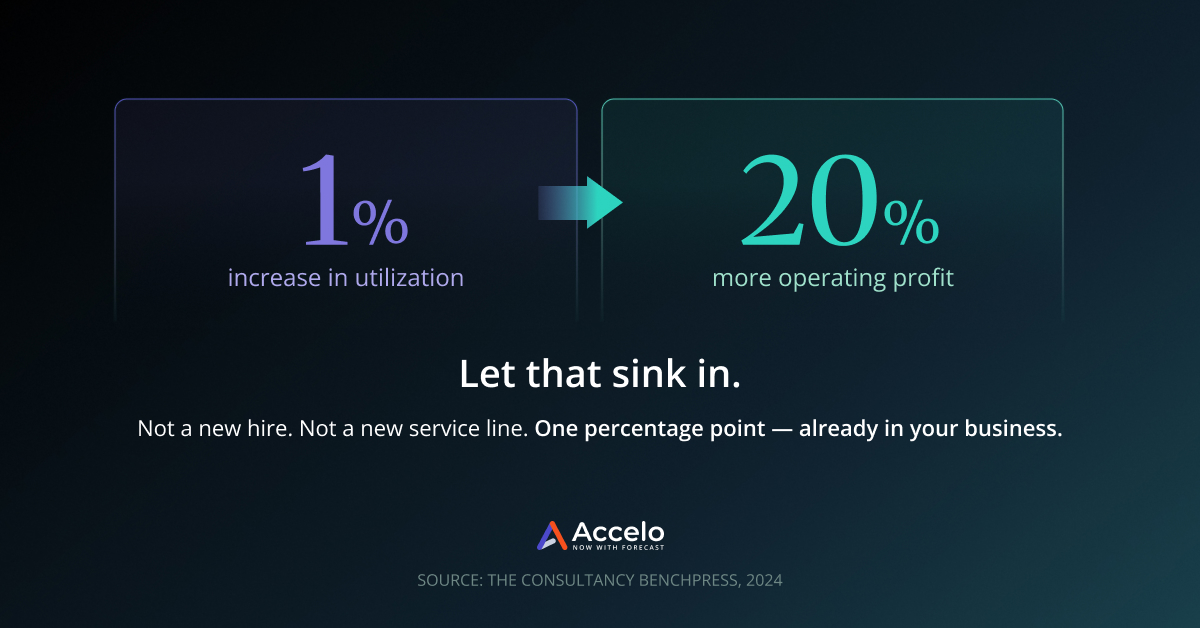
Research from Consultancy BenchPress (2024) found that a 1% improvement in utilization can increase operating profit by as much as 20%, highlighting why effective resource management has such a significant impact on profitability.
Organizations that manage resources effectively are better able to:
- Match work to available capacity
- Reduce bench time and idle capacity
- Prevent employee burnout and over-allocation
- Improve utilization rates
- Deliver projects on schedule
- Forecast future hiring needs
- Protect project profitability
- Respond more quickly to changing client priorities
Poor resource management often results in missed deadlines, uneven workloads, unnecessary hiring, lower margins, and dissatisfied clients.
What Is a Resource in Project Management?
In project management, a resource is anything required to complete work successfully.
Resources commonly include:
While people remain the most valuable resource for most professional services organizations, AI is rapidly becoming another deployable resource. AI can automate administrative work, summarize communications, generate documentation, assist with planning, and accelerate delivery, allowing human experts to focus on higher-value client work.
As organizations adopt AI, resource management is evolving from balancing human capacity alone to orchestrating a hybrid workforce of people and intelligent technology.
Related Reading: Balancing Human and AI Resources: A New Approach to Capacity Management
Resource Management Process: 5 Key Steps
The resource management process is an ongoing cycle of forecasting demand, evaluating available capacity, allocating resources, monitoring project health, and adjusting plans as priorities change. Rather than creating a static project plan, effective resource management continuously adapts to new work, changing deadlines, and evolving business needs.
Most organizations continuously move through five stages:
- Forecast upcoming demand
- Assess available capacity
- Allocate the right resources
- Monitor workloads and project health
- Adjust plans as priorities change
Rather than creating static project plans, leading organizations continuously rebalance work based on changing deadlines, client requests, utilization, and capacity.
Resource Management vs. Resource Allocation
Although the terms are often used interchangeably, resource management and resource allocation describe different activities.
Resource management is the overall discipline of planning, scheduling, monitoring, and optimizing resources across the organization.
Resource allocation is one part of resource management. It focuses specifically on assigning individual resources to specific projects or tasks.
Think of resource allocation as one decision within the larger resource management process.
Related: What Is Resource Allocation?
Common Resource Management Challenges
Even organizations with mature project management practices frequently struggle with resource management.
Common challenges include:
- Over-allocated employees
- Resource bottlenecks
- Competing project priorities
- Inaccurate capacity forecasts
- Last-minute staffing changes
- Uneven utilization
- Limited visibility across multiple projects
- Difficulty coordinating both human and AI resources
These challenges often become more difficult as organizations grow because more projects, clients, and delivery teams compete for the same limited resources.
How is AI Changing Resource Management?
Artificial intelligence is transforming resource management from reactive scheduling into predictive planning.
Instead of relying solely on spreadsheets and manual updates, AI can help organizations:
- Forecast future resource demand
- Predict staffing shortages
- Identify utilization risks
- Recommend optimal resource assignments
- Detect projects likely to miss deadlines
- Surface margin risks before they become financial problems
- Continuously rebalance workloads as priorities change
As AI agents begin handling more operational work, organizations must also manage AI capacity alongside human capacity. Modern resource management increasingly focuses on deploying the right combination of people and AI to deliver work efficiently while maintaining quality. See how Accelo combines AI-assisted resource management, predictive capacity planning, and intelligent resource allocation to help professional services organizations stay ahead of demand and protect their margins.
What Are the Benefits of Resource Management Software?
Resource management becomes increasingly difficult as organizations grow. Multiple projects, changing priorities, and limited visibility make it challenging to understand who is available, who is overloaded, and where future capacity exists. While spreadsheets can support basic resource planning, they become increasingly time-consuming and difficult to manage as organizations scale. Without real-time visibility into workloads, utilization, and future capacity, teams often rely on outdated information, leading to resource conflicts, missed deadlines, and reactive staffing decisions.
Resource management software provides a centralized view of workloads, project schedules, capacity, and resource availability, making it easier to make informed staffing decisions and respond quickly when priorities change. For professional services organizations, modern Professional Services Automation (PSA) platforms go beyond basic scheduling by connecting resource management with projects, time tracking, financials, and client work in a single system.
The Consultancy Benchpress found that consultancies using a PSA platform outperform those relying primarily on spreadsheets, achieving higher gross margins (44% vs. 37%) and higher average utilization (70% vs. 68%). These findings suggest that connected systems provide organizations with better visibility, more accurate forecasting, and more informed resource decisions than manual planning methods. As organizations begin managing both human and AI resources, connected PSA platforms provide the visibility needed to plan capacity across an increasingly hybrid workforce.
AI-powered PSA platforms, such as Accelo, build on these capabilities by predicting capacity constraints, identifying delivery risks, and recommending staffing adjustments before problems impact project delivery or profitability.
We reduced the time spent on resourcing by more than 50%. The biggest change since introducing Accelo, now with Forecast, has been having this level of transparency and being able to make dedicated, data-driven decisions based on accurate and real-time information. - Verena Ott, Resource Manager, Spryker (Germany)
How Accelo Improves Resource Management
Accelo helps professional services organizations manage both today's workload and tomorrow's capacity. By connecting sales, projects, resources, time tracking, and financial data in a single PSA platform, Accelo gives teams real-time visibility into availability, utilization, project health, and future demand. AI-powered forecasting helps identify resource constraints, predict delivery risks, and recommend optimal staffing decisions so organizations can improve utilization, protect margins, and deliver projects more predictably.
Related Reading
- Best Resource Management Software (And How to Choose the Right One)
- Capacity Planning Tools, Methods & Best Practices
- Calculating Resource Utilization and Billable Utilization Rate (And How to Improve Both)
- Professional Services Performance Benchmarks Report
FAQs About Resource Management
Is resource management the same as resource planning?
No. Resource planning focuses on forecasting future capacity needs, while resource management includes planning, allocation, scheduling, monitoring, and optimization throughout project delivery.
What is the difference between resource management and resource allocation?
Resource allocation is the process of assigning resources to specific work. Resource management is the broader discipline of planning, monitoring, and optimizing resources across projects and teams.
What is resource management software?
Resource management software helps organizations plan, schedule, allocate, and monitor resources across projects. Many professional services organizations use PSA software because it combines resource management with project management, time tracking, financial management, and forecasting.
Can AI improve resource management?
Yes. AI can forecast capacity, identify staffing conflicts, predict project risks, recommend resource assignments, and automate administrative work, allowing organizations to make faster, more informed resource decisions.

.svg)